
The automotive world is evolving at a speed never witnessed before. Today’s vehicles are no longer just machines that respond to human input. They are intelligent systems capable of thinking, reacting, and acting faster than the person behind the wheel.
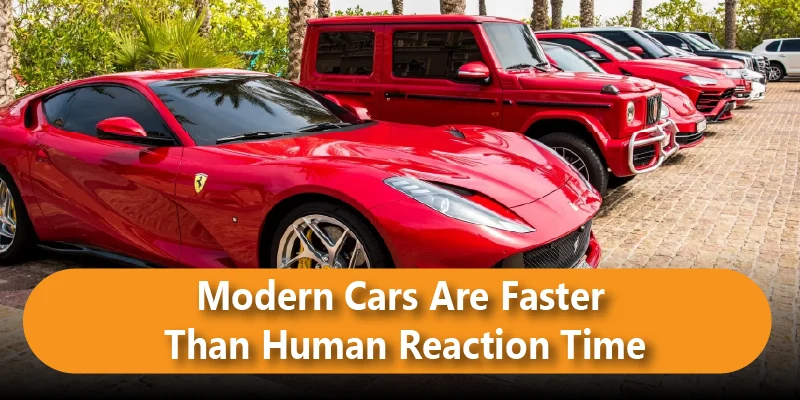
With the rapid modern car’s speed, lightning-fast vehicle acceleration, and next-generation car braking systems, a critical question arises: are cars now faster than human reaction time itself?
Studies show that the average driving response time for a human is around 1.5 to 2 seconds. In contrast, modern vehicles equipped with advanced sensors and processors can react in milliseconds. This widening gap between human capability and machine response is redefining road safety, driving responsibility, and the future of mobility.
Why Human Reaction Time Can’t Keep Up Anymore
The human brain processes visual information, decides on an action, and then sends a signal to the muscles. This natural delay has always existed. However, today’s high performance cars can accelerate from zero to highway speeds in under three seconds, leaving very little margin for error.
Add busy urban roads, distracted driving, and unpredictable traffic conditions, and the limitations of human reaction time become even more apparent. This is precisely where automotive technology steps in to bridge the gap.
How Automotive Technology Is Beating Human Reflexes
Modern vehicles are no longer passive tools. They actively monitor the road and make split-second decisions using cameras, radar, and AI-powered software. These innovations allow cars to respond faster than any human ever could.
Advanced car braking systems can detect obstacles and apply brakes before a driver even realizes danger. Autonomous driving tech continuously analyzes surroundings, predicts risks, and reacts instantly. Meanwhile, advanced safety systems such as lane assist and adaptive cruise control reduce dependency on delayed human reactions.
This level of car safety innovation is not about replacing drivers, but protecting them.
The Rise of High Performance Cars and Safety Challenges
While high performance cars showcase incredible engineering, they also raise safety concerns. Faster vehicle acceleration demands faster decision-making, something humans struggle to match consistently.
Without the support of intelligent systems, drivers may find themselves overwhelmed. That’s why manufacturers are investing heavily in advanced safety systems to ensure speed and safety evolve together.
Essential Driving Tips for the Age of Intelligent Cars
Understanding your car’s safety features is no longer optional. Knowing how car braking systems and driver-assist tools work can significantly improve real-world safety. Maintaining safe distances remains critical, even with smart technology. Drivers must stay alert and avoid overconfidence in autonomous driving tech, remembering that human judgment still plays a role.
Regular software updates and system checks ensure that automotive technology performs as intended. Responsible driving combined with intelligent systems creates the safest outcome.
Common Myths About Speed and Safety in Modern Cars
Many drivers believe faster cars are automatically more dangerous, but the truth is more nuanced. Speed itself is not the problem; delayed driving response time is. Another misconception is that autonomous driving tech eliminates the need for driver attention. In reality, it enhances safety but still relies on human supervision.
Some also assume advanced systems fail easily, yet modern car safety innovation undergoes rigorous testing to perform reliably in real-world conditions.
Human Reaction vs Modern Car Response
| Factor | Human Driver | Modern Vehicle Systems |
| Reaction Speed | 1.5 to 2 seconds human reaction time | Milliseconds response |
| Braking Response | Delayed by perception | Instant car braking systems |
| Hazard Detection | Limited field of vision | 360-degree sensor coverage |
| Fatigue Impact | High | None |
| Consistency | Variable | Highly consistent |
This comparison clearly shows how automotive technology is redefining safety standards.
What This Means for Road Safety in the Future
As modern cars speed continues to increase, safety will rely less on human reflexes and more on intelligent systems. The future of driving is a partnership where humans provide judgment and machines provide precision.
The integration of advanced safety systems and autonomous driving tech will not only reduce accidents but also change how we define driver responsibility.
Frequently Asked Questions
1. Are modern cars really faster than human reaction time?
Yes. Most modern vehicles respond in milliseconds, while human reaction time takes over a second.
2. Do advanced braking systems work without driver input?
Yes. Many car braking systems activate automatically when a collision risk is detected.
3. Are high performance cars more dangerous?
Not necessarily. With proper advanced safety systems, high performance cars can be safer than older models.
4. Can autonomous technology replace human drivers completely?
Currently, autonomous driving tech assists drivers rather than fully replacing them.
5. How can drivers adapt to faster vehicles?
Understanding vehicle systems, maintaining focus, and respecting speed limits are key to managing driving response time.
Final Thoughts: Speed Needs Intelligence, Not Just Skill
The reality is clear. Cars are evolving faster than human reflexes, but that doesn’t mean drivers are becoming irrelevant. It means safety is becoming smarter. With cutting-edge automotive technology and continuous car safety innovation, roads can become safer despite rising speeds.
Stay Informed with Miss Auto UAE
Time to Machine Precision: Read the Latest on Miss Auto UAE
At Miss Auto UAE, we bring you the latest insights, expert analysis, and breaking updates from the automotive world.
From modern cars speed innovations to the newest advanced safety systems, we keep you informed so you can drive smarter and safer.
Visit to Miss Auto UAE for the latest automotive news, trends, and expert articles that matter to today’s drivers and tomorrow’s roads.
Stay informed. Stay safe. Drive the future with confidence.