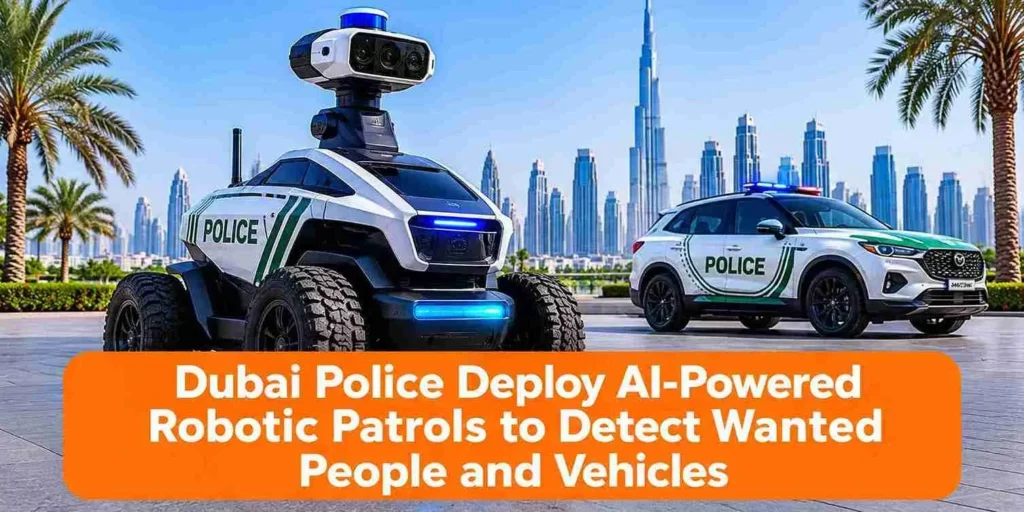
Dubai is taking another major step towards smarter public safety with the introduction of advanced robotic patrol technology by Dubai Police. Equipped with artificial intelligence (AI), facial recognition and intelligent surveillance systems, the upgraded robotic patrol can identify wanted individuals, detect vehicles with flagged registration numbers and recognise suspicious activities.

The upgraded DPR2 Autonomous Robotic Patrol was showcased at the World Police Summit 2026 in Dubai, demonstrating how robotics and AI are becoming increasingly important in modern law enforcement.
Developed in collaboration with Micropolis, the fully electric, four-wheeled robotic patrol is designed to operate autonomously without requiring a human driver. Its advanced technology combines facial recognition, Automatic Number Plate Recognition (ANPR) and predictive behavioural analysis to identify potential security concerns.
The system can also recognise suspicious incidents such as street fights, theft and individuals carrying bladed weapons. When potentially criminal activity is detected, the robotic unit automatically sends an alert to the Dubai Police Operations Room, allowing officers to review the information and determine the appropriate response.
This development highlights Dubai’s continued investment in smart policing, autonomous systems and AI-powered security infrastructure.
So, how do Dubai Police robotic patrols work? Can these robots really identify wanted people and vehicles? And what does this technology mean for the future of public safety in the UAE? Here is everything you need to know about Dubai’s latest robotic security innovation.
Dubai Police Robotic Patrols: Key Highlights at a Glance
Here are the major features of Dubai Police’s upgraded DPR2 Autonomous Robotic Patrol.
| Feature | Details |
| Organisation | Dubai Police |
| Robotic patrol | DPR2 Autonomous Robotic Patrol |
| Development partner | Micropolis |
| Technology | Artificial Intelligence (AI) |
| Vehicle type | Fully electric, four-wheeled robot |
| Facial recognition | Identifies potential matches involving wanted individuals |
| Number plate recognition | Detects vehicles with flagged registration numbers |
| Behavioural analysis | Recognises suspicious activities |
| Security monitoring | Theft, street fights and bladed weapons |
| Alert system | Dubai Police Operations Room |
| Main purpose | Autonomous surveillance and smart policing |
| Showcase event | World Police Summit 2026 |
| Location | Dubai, UAE |
The upgraded robotic patrol combines several intelligent monitoring technologies to support existing police operations and strengthen security surveillance.
Dubai Police Introduces Upgraded DPR2 Autonomous Robotic Patrol
Dubai Police presented its upgraded DPR2 Autonomous Robotic Patrol at the World Police Summit 2026, showcasing how autonomous technology can support modern security operations.
The new robotic unit is designed to monitor its surroundings, identify potential security threats and communicate relevant information to police officers through an automated alert system.
One of its most important capabilities is facial recognition technology, which can identify potential matches involving individuals listed as wanted. The system can also scan vehicle registration plates and detect vehicles associated with flagged numbers.
Unlike conventional surveillance cameras that primarily capture and record footage, the robotic patrol combines visual monitoring with intelligent detection capabilities. This allows it to identify potential concerns and automatically notify the police operations team.
The DPR2 is a fully electric, four-wheeled robotic unit that can operate independently without a human driver. Its autonomous capabilities make it an additional resource for monitoring designated areas and supporting conventional police patrols.
During the exhibition, Dubai Police highlighted how the technology could improve surveillance coverage, particularly in residential neighbourhoods and other public environments where continuous monitoring is important.
The development demonstrates how intelligent robotics can become part of a wider security network, helping police officers receive relevant information and respond to potential incidents more efficiently.
How Does Dubai Police's AI-Powered Robotic Patrol Work?
The upgraded Dubai police robot patrol combines artificial intelligence, advanced sensors, cameras and automated monitoring systems to analyse its surroundings.
Its technology is designed to recognise people, scan vehicles and identify suspicious activities that may require police attention.
Here are the major technologies powering the robotic patrol.
1. Facial Recognition Technology
Facial recognition is one of the key features of the upgraded DPR2.
The system analyses facial information to identify potential matches against relevant police records. When a possible match involving a wanted individual is detected, the robotic patrol can notify the police operations team.
This technology supports identification during routine surveillance and reduces the dependence on manual observation alone.
2. Automatic Number Plate Recognition
The robotic patrol also features Automatic Number Plate Recognition (ANPR).
This technology uses cameras and intelligent image processing to read vehicle registration plates. The information can then be checked against relevant flagged vehicle records.
If a vehicle associated with a wanted registration number is identified, the system can send an alert for further assessment.
This capability could support security monitoring across roads, residential communities and other designated public areas.
3. Predictive Behavioural Analysis
Another important feature is predictive behavioural analysis.
The robotic patrol is designed to recognise suspicious activities through intelligent visual monitoring. These include street fights, suspected theft and individuals carrying bladed weapons.
By analysing activities in its surroundings, the system can identify situations that may require police attention.
When potentially criminal activity is detected, an automated notification is sent to the Dubai Police Operations Room, allowing officers to assess the situation and decide on the appropriate response.
The combination of these technologies makes the DPR2 more than a conventional surveillance unit. It functions as an intelligent monitoring system capable of identifying potential security concerns.
Can Dubai Police Robots Detect Wanted People and Vehicles?
Yes. Detecting wanted individuals and vehicles is among the most notable capabilities of Dubai Police’s upgraded robotic patrol.
The DPR2 combines facial recognition and number plate recognition technologies to monitor both individuals and vehicles.
For people, its facial recognition system can identify potential matches against relevant police information. For vehicles, its ANPR technology scans registration plates to identify those associated with flagged records.
For example, if the robotic patrol detects a vehicle carrying a registration number linked to a wanted vehicle record, it can identify the potential match and send an alert to the police operations team.
Similarly, if the facial recognition system identifies a possible match involving a wanted individual, officers can receive the information for further verification.
This creates an additional layer of smart police surveillance, helping police identify potential concerns during routine monitoring.
However, an automated identification does not automatically establish criminal activity. Police officers remain responsible for verifying alerts, assessing the available information and deciding whether further action is necessary.
The main advantage is that AI-powered identification technology can support police officers by making relevant information available more efficiently.
What Suspicious Activities Can Dubai's Robotic Patrol Identify?
Beyond detecting wanted individuals and vehicles, the autonomous robotic patrol is designed to identify different types of suspicious activities.
Its intelligent monitoring capabilities can recognise incidents that may require attention from law enforcement agencies.
Some of the activities highlighted by Dubai Police include:
- Street fights: Identifying physical altercations and potentially violent incidents in public spaces.
- Theft: Recognising suspected theft-related activities through visual monitoring.
- Bladed weapons: Detecting individuals carrying bladed weapons.
- Traffic violations: Supporting the identification of traffic-related offences.
- Public violations: Monitoring activities that may involve violations of applicable public safety regulations.
When the system identifies potentially criminal activity, it can automatically send an alert to the Dubai Police Operations Room.
Officers can then review the information and determine whether a response is required.
This combination of autonomous surveillance and intelligent activity recognition could help improve the efficiency of security monitoring across designated locations.
How Can Autonomous Police Robots Improve Security in Dubai?
The introduction of AI-powered police robots could bring several advantages to Dubai’s existing law enforcement infrastructure.
Conventional police patrols rely on officers travelling through assigned areas, observing their surroundings and responding to reported incidents. Autonomous robotic patrols can complement these activities by providing additional monitoring capabilities.
Here are some of the potential benefits.
Continuous Security Monitoring
Autonomous robotic patrols can monitor designated surroundings without requiring a human driver. This provides an additional resource for observing public spaces and identifying potential security concerns.
Faster Identification of Potential Threats
Facial recognition, number plate recognition and behavioural analysis can help identify potential security concerns during routine surveillance.
Automated alerts also allow relevant information to reach the police operations team without relying entirely on manual reporting.
Improved Police Operational Efficiency
Robotic patrols can support routine surveillance and automated detection, allowing police officers to focus their attention on situations requiring human assessment and intervention.
Additional Security Coverage
Autonomous surveillance units can provide another layer of monitoring in residential neighbourhoods and other designated environments.
This can complement existing police patrols and conventional security cameras.
Reduced Human Involvement in Routine Monitoring
Since the DPR2 is designed to operate independently, it can perform certain surveillance activities without a human driver. This could help reduce the need for direct human involvement in routine monitoring tasks.
Overall, the technology demonstrates how AI and robotics can support law enforcement while improving the use of existing security resources.
Dubai Police and Micropolis: Partnership Behind the Robotic Patrol
The upgraded DPR2 Autonomous Robotic Patrol was developed through a collaboration between Dubai Police and Micropolis, a company specialising in autonomous robotics and AI-powered technologies.
The partnership brings together robotics expertise and law enforcement requirements to develop intelligent security solutions.
Micropolis contributes its autonomous technology capabilities, while Dubai Police brings its operational experience and security objectives to the development.
The resulting robotic patrol features a fully electric, four-wheeled design with intelligent monitoring systems and autonomous operating capabilities.
Its combination of facial recognition, number plate detection and behavioural analysis demonstrates the potential of robotics in modern policing.
The collaboration also reflects the growing interest in autonomous security technologies as cities explore new ways to improve public safety and operational efficiency.
World Police Summit 2026: Dubai Showcases the Future of Smart Policing
The upgraded robotic patrol was among the advanced security technologies showcased by Dubai Police at the World Police Summit 2026, held at Dubai World Trade Centre.
The international event brought together police leaders, security professionals, government representatives and technology experts to discuss developments in law enforcement and public safety.
Dubai Police presented several technology-driven initiatives focusing on artificial intelligence, digital transformation, proactive security and intelligent surveillance.
Alongside the DPR2 robotic patrol, the exhibition featured the Smart Security Mapping Platform, which uses digital maps and interactive dashboards to support geographical analysis and security monitoring.
The Ghiath smart security patrol was also showcased with advanced surveillance, communication and security response capabilities.
These developments highlight how Dubai is integrating AI, automation and intelligent monitoring into different areas of law enforcement.
The summit also provided an opportunity to demonstrate how emerging technologies can support police officers, improve security coverage and strengthen operational decision-making.
What Does Dubai's Robotic Patrol Mean for the Future of Smart Security?
The introduction of upgraded autonomous police robots represents another step in Dubai’s wider smart city and digital transformation initiatives.
As cities become increasingly connected, law enforcement agencies are exploring technologies that can improve surveillance, identify potential threats and support efficient responses.
AI-powered robotic patrols could become valuable tools for monitoring public spaces, residential communities and other locations requiring additional security coverage.
Their ability to combine facial recognition, vehicle number plate detection and behavioural analysis creates opportunities for more intelligent surveillance operations.
However, the effectiveness of these systems also depends on accurate identification, responsible data management and appropriate human oversight.
Automated systems can identify potential security concerns, but police officers must assess alerts and determine the appropriate course of action.
Dubai’s latest robotic patrol demonstrates how autonomous technology can complement conventional policing while supporting the development of smarter security infrastructure.
As artificial intelligence and robotics continue to evolve, further innovations in autonomous surveillance could influence how public safety operations are managed across the UAE.
Final Words
Dubai Police’s upgraded DPR2 Autonomous Robotic Patrol highlights how artificial intelligence and robotics are transforming modern law enforcement.
With facial recognition, Automatic Number Plate Recognition and predictive behavioural analysis, the robotic patrol can identify potential matches involving wanted individuals, detect vehicles with flagged registration numbers and recognise suspicious activities.
Its ability to operate autonomously without a human driver and automatically alert Dubai Police’s Operations Room makes it an important development in smart security technology.
Showcased at the World Police Summit 2026, the innovation also reflects Dubai’s continued focus on adopting advanced technologies to strengthen public safety, improve surveillance and support frontline police officers.
Although robotic patrols are designed to complement conventional policing rather than replace human officers, their capabilities demonstrate the growing potential of AI-powered security solutions.
Stay connected with Miss Auto UAE for the latest UAE technology updates, smart mobility developments, automotive innovations, Dubai news and important developments shaping the future of transportation and security.
Frequently Asked Questions
What are Dubai Police robotic patrols?
Dubai Police robotic patrols are autonomous security units equipped with artificial intelligence, cameras, sensors and intelligent monitoring systems. The upgraded DPR2 can identify potential matches involving wanted individuals, detect flagged vehicles and recognise suspicious activities.
Can Dubai Police's robotic patrol detect wanted people?
Yes. The DPR2 uses facial recognition technology to identify potential matches involving wanted individuals and notify Dubai Police for further assessment.
How does the Dubai Police robot identify wanted vehicles?
The robotic patrol uses Automatic Number Plate Recognition (ANPR) technology to scan vehicle registration plates and identify vehicles associated with flagged registration numbers.
What suspicious activities can the DPR2 robotic patrol detect?
Its AI-powered monitoring system is designed to identify suspicious activities such as street fights, suspected theft and individuals carrying bladed weapons. It can also support the identification of traffic and public violations.
Who developed Dubai Police's upgraded robotic patrol?
The upgraded DPR2 Autonomous Robotic Patrol was developed through a partnership between Dubai Police and Micropolis. It was showcased at the World Police Summit 2026 in Dubai.

