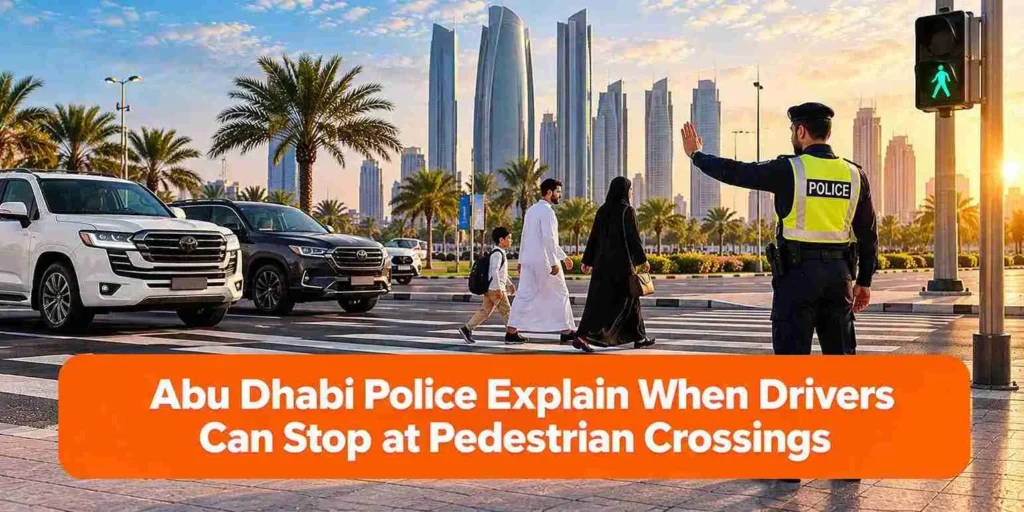
According to the police, drivers who stop on a pedestrian crossing at traffic lights to make way for an emergency vehicle approaching from behind will not be committing a traffic offence in this specific situation.
The clarification highlights the importance of allowing ambulances, Civil Defence vehicles and other emergency responders to reach incidents without unnecessary delays. At the same time, motorists must ensure that their actions do not endanger pedestrians or other road users.
The announcement is particularly relevant to the Abu Dhabi pedestrian crossing rules, as drivers must balance pedestrian safety with the need to respond appropriately when emergency vehicles approach.
Here is what motorists need to know about the police clarification, pedestrian crossing responsibilities, common mistakes and essential UAE road safety regulations.
Abu Dhabi Pedestrian Crossing Rules: What Has Police Clarified?
Abu Dhabi Police shared the clarification in a video published on its official X account. The message addressed situations in which a driver is stopped at a traffic light and an emergency vehicle approaches from behind.
In these circumstances, a motorist may need to move forward cautiously to create space for the emergency vehicle, even if doing so means stopping on a pedestrian crossing.
Police clarified that stopping on the crossing for this specific reason does not constitute a traffic offence.
Key Details at a Glance
| Situation | What Drivers Should Know |
| Emergency vehicle approaches from behind | Give way safely and promptly |
| Vehicle is stopped at a red light | Make room when necessary and safe |
| Moving forward requires entering a pedestrian crossing | Proceed cautiously and avoid endangering pedestrians |
| Pedestrians are crossing | Give them priority and avoid putting them at risk |
| Emergency vehicle is approaching | Watch for sirens and flashing lights |
The clarification is intended to help emergency responders reach accident scenes and other urgent incidents more quickly.
However, it should not be interpreted as a general exemption from pedestrian crossing rules. Drivers must still exercise caution and avoid unnecessary obstruction of designated crossings.
When Can Drivers Stop at Pedestrian Crossings?
The question of when drivers can stop at pedestrian crossings depends on the circumstances.
Under the situation clarified by Abu Dhabi Police, a driver stopped at traffic lights may move forward carefully to make way for an emergency vehicle approaching from behind.
For example, a motorist waiting at a red light may hear an ambulance siren and notice the vehicle behind them. If there is no safe space for the ambulance to pass, the driver may need to create room by moving forward, even if the vehicle ends up on the marked crossing.
In this situation, the police clarification recognises the need to facilitate an emergency response.
Drivers should nevertheless check for pedestrians and move only when it is safe to do so. They should avoid sudden manoeuvres that could cause a collision, force pedestrians to change direction or create another dangerous situation.
The important point: Making way for an emergency vehicle is different from stopping on a pedestrian crossing out of convenience or blocking it during ordinary traffic conditions.
Which Emergency Vehicles Should Drivers Give Priority To?
Abu Dhabi Police has highlighted the importance of allowing emergency responders to move through traffic without unnecessary delays.
These include:
1. Ambulances
Ambulances may be responding to medical emergencies where delays can affect patient outcomes. Drivers should remain alert to sirens and flashing lights and create a safe path when possible.
2. Civil Defence Vehicles
Civil Defence teams respond to fires, rescue operations and other emergencies. Allowing their vehicles to pass can help emergency personnel reach incidents more quickly.
3. Other Emergency Responders
Other authorised emergency vehicles may also require priority depending on the situation. Motorists should remain attentive and respond calmly when they identify an approaching emergency vehicle.
Drivers should not panic, accelerate through an intersection or make an unsafe lane change. The objective is to provide a clear path without creating additional risks.
UAE Pedestrian Crossing Laws: What Must Drivers Do?
The recent clarification does not remove motorists’ responsibilities towards pedestrians.
Abu Dhabi Police has repeatedly reminded drivers to slow down when approaching designated crossings and give pedestrians priority. Motorists should remain particularly vigilant near schools, residential neighbourhoods and other areas with regular pedestrian movement.
Slow Down Before Reaching the Crossing
Reduce speed when approaching a marked pedestrian crossing. Look for people waiting to cross as well as those already on the road.
Approaching too quickly can make it difficult to stop safely, particularly when visibility is limited.
Give Pedestrians Time to Cross
Drivers should allow pedestrians to cross safely before proceeding. Do not accelerate towards someone who is still using the crossing or attempt to pass closely behind them.
Observe Traffic Signals
At signal-controlled crossings, follow the applicable traffic signals and instructions. A green light for vehicles does not justify driving into a crossing that remains occupied by pedestrians.
Avoid Blocking Crossings Unnecessarily
Do not enter a crossing when traffic ahead is stationary and there is insufficient space to clear it. Blocking the crossing can force pedestrians to move around vehicles and may expose them to traffic.
The emergency-vehicle situation described by police is a specific exception in practice, not a reason to disregard these everyday precautions.
Pedestrian Safety UAE: What Should Walkers Remember?
Road safety is a shared responsibility. Although motorists must exercise caution, pedestrians must also follow crossing rules and avoid risky behaviour.
Abu Dhabi Police advises pedestrians to use designated crossings, pedestrian bridges and underpasses, where available, and obey pedestrian traffic signals.
Here are some important precautions.
- Use designated crossing points: Avoid crossing between vehicles or at locations where drivers cannot anticipate pedestrian movement.
- Follow pedestrian signals: Wait for the appropriate signal before crossing at controlled intersections.
- Stay alert: Avoid distractions, including mobile phone use, while crossing the road.
- Check approaching traffic: Look carefully before stepping onto the road, even at a designated crossing.
- Avoid rushing: Do not run across busy roads or attempt to cross when vehicles are approaching too closely.
Under UAE traffic rules, pedestrians who fail to follow traffic signals or cross roads from undesignated areas can face a Dh400 fine. More serious penalties may apply when unlawful crossing results in an accident, depending on the circumstances and applicable law.
What Happens If Drivers Fail to Give Way to Pedestrians?
Failing to give pedestrians priority at designated crossings is a traffic offence.
Earlier Abu Dhabi Police guidance has identified a penalty of Dh500 and six traffic black points for failing to give priority to pedestrians at designated crossings. Motorists should check current official traffic guidance for the applicable penalty and any subsequent regulatory changes.
Drivers should understand that pedestrian crossings are designated safety areas, not spaces to use when traffic is congested.
Common mistakes include accelerating before a pedestrian has finished crossing, approaching too quickly, failing to notice people waiting at the roadside and entering a crossing when there is no room to continue.
Avoiding these behaviours protects vulnerable road users and helps prevent collisions.
Abu Dhabi Traffic Rules: How to Respond Safely to Emergency Vehicles
When an emergency vehicle approaches, drivers should remain calm and make decisions based on the surrounding traffic conditions.
Listen for Sirens and Watch for Flashing Lights
Emergency vehicles may approach from behind or from another direction. Check mirrors regularly and identify the vehicle’s likely path before taking action.
Make Room Without Creating Another Hazard
Move aside or forward cautiously when appropriate. Check nearby lanes, pedestrians and the space ahead before changing position.
Avoid Sudden Braking or Unpredictable Movements
Abrupt manoeuvres can confuse other drivers and increase the risk of a collision. Signal where appropriate and move predictably.
Follow Police Instructions
If a police officer is directing traffic, follow their instructions. Do not assume that a traffic signal or usual driving routine takes precedence over an officer’s directions.
These precautions help emergency vehicles proceed while maintaining safety for pedestrians and other motorists.
Final Words
The Abu Dhabi pedestrian crossing rules clarification addresses an important situation: drivers stopped at traffic lights may stop on a pedestrian crossing when necessary to make way for an emergency vehicle approaching from behind, without committing a traffic offence in that specific circumstance.
Abu Dhabi Police has stressed the importance of allowing ambulances, Civil Defence vehicles and other emergency responders to reach incidents quickly.
However, motorists must still prioritise pedestrian safety, obey traffic signals and avoid unnecessary obstruction of crossings. Pedestrians should also use designated crossing points and follow traffic signals.
The safest approach is to remain alert, assess the situation carefully and make room for emergency vehicles without creating another hazard.
For more UAE automotive news, traffic updates and road-safety guides, connect with Miss Auto UAE.
Frequently Asked Questions
Can drivers stop on pedestrian crossings in Abu Dhabi?
Abu Dhabi Police has clarified that drivers who stop on a pedestrian crossing at traffic lights to make way for an emergency vehicle approaching from behind will not be committing a traffic offence in that specific situation.
Which emergency vehicles should drivers give way to?
Police have highlighted ambulances, Civil Defence vehicles and other emergency responders. Motorists should watch for sirens and flashing lights and make their way safely.
Do drivers still need to give pedestrians priority?
Yes. Motorists must continue to exercise caution near designated crossings and allow pedestrians to cross safely. The emergency-vehicle clarification is not a general exemption from pedestrian safety responsibilities.
What is the fine for failing to give way to pedestrians in Abu Dhabi?
Earlier Abu Dhabi Police guidance identified a Dh500 fine and six traffic black points for failing to give priority to pedestrians at designated crossings. Check current official guidance for the applicable penalty.
What is the fine for jaywalking in the UAE?
Pedestrians who fail to follow traffic signals or cross roads from undesignated areas can face a Dh400 fine. More serious penalties may apply if unlawful crossing results in an accident.