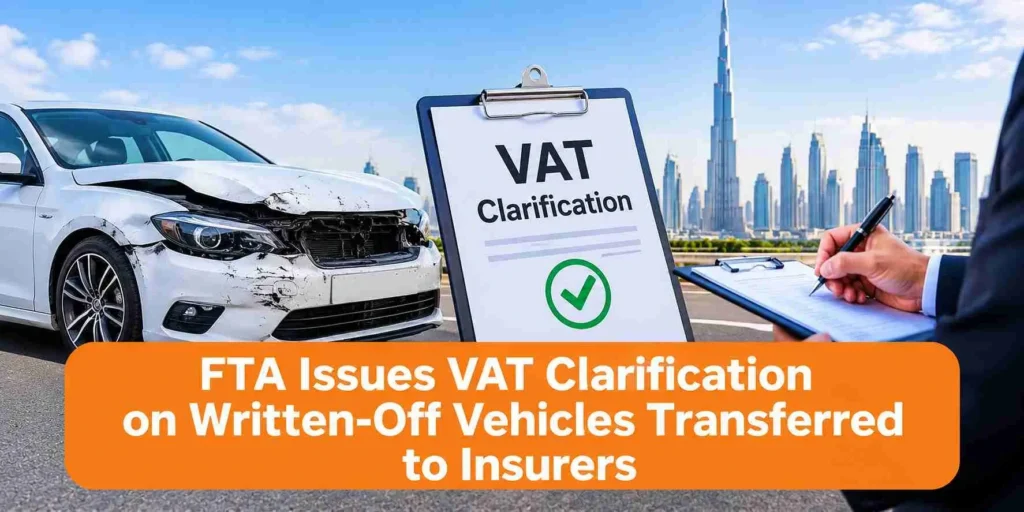
Motorists and insurance companies in the UAE have received an important tax clarification regarding vehicles declared a total loss. The Federal Tax Authority (FTA) has confirmed that transferring ownership of written-off vehicles to insurance companies as part of an insurance claim settlement does not attract Value Added Tax (VAT), provided no separate payment is made beyond the insurance compensation.
The clarification was issued under Directive on Tax Transactions No. 6 of 2026, published on November 18, 2026. It establishes how VAT should be treated when an insured vehicle or another insured asset is damaged beyond safe or economically viable repair and the insurance company takes ownership after compensating the policyholder.

The announcement is particularly relevant to motorists whose vehicles are severely damaged in road accidents, fires or extreme weather conditions. In such cases, insurance companies may declare the vehicle a total loss, pay the agreed compensation and take ownership of the damaged vehicle or its remaining parts.

Under the new clarification, this ownership transfer is not treated as a separate supply of goods for VAT purposes when it forms part of the insurance settlement and involves no additional consideration.

The directive also covers other insured assets, including machinery, equipment and property.

So, what does the new FTA clarification mean for written-off vehicles in the UAE? When does VAT apply to an insurance write-off? And how will the directive affect insurers and vehicle owners? Here is everything you need to know.

VAT on Written-Off Vehicles UAE: Key Highlights at a Glance

Here are the major details of the FTA’s latest VAT clarification.

Feature Details
Issuing authority Federal Tax Authority (FTA)
Directive Tax Transactions Directive No. 6 of 2026
Publication date November 18, 2026
Main subject VAT treatment of insured assets transferred after total loss
Applicable assets Vehicles, machinery, equipment and property
Transfer to insurer Not treated as a supply of goods for VAT
Main condition No separate consideration beyond insurance compensation
Insurance compensation Not considered payment for purchasing the damaged asset
Subsequent resale Subject to general UAE VAT rules
Documentation Required for insurers and policyholders

The clarification distinguishes between transferring a written-off asset to an insurance company during claim settlement and the insurer subsequently selling that asset to another party.

UAE FTA Clarifies VAT Treatment of Written-Off Vehicles

The UAE Federal Tax Authority has issued a new directive addressing the VAT treatment of insured assets transferred to insurance companies following a total loss.

Under Directive on Tax Transactions No. 6 of 2026, the transfer of ownership from a policyholder to an insurer is not considered a supply of goods for VAT purposes when it takes place as part of an insurance claim settlement.

This applies when the insured vehicle or asset cannot be repaired safely or when the cost of repairing it is economically unviable.

In these situations, the insurance company assesses the damage, declares the asset a total loss and compensates the policyholder according to the insurance agreement. Ownership of the damaged asset is then transferred to the insurer.

The FTA has clarified that the insurance compensation is not treated as a purchase payment for the damaged vehicle. Similarly, the value assigned to the vehicle during the insurer’s loss assessment does not represent separate consideration for transferring ownership.

Consequently, the transfer does not create an independent transaction subject to VAT, provided the policyholder receives no additional payment beyond the insurance compensation.
This clarification provides greater certainty for insurance companies and vehicle owners handling total-loss claims.

When Does the No-VAT Rule Apply to Insurance Write-Off Vehicles?

The VAT clarification applies to specific circumstances involving insured assets declared a total loss.

For the transfer to fall within the treatment outlined in the directive, the following conditions must be met:

1. The Asset Must Be Declared a Total Loss

The insured vehicle or asset must be considered beyond safe or economically viable repair. The insurance company determines the total-loss status as part of the claim assessment.

2. The Transfer Must Be Part of an Insurance Settlement

Ownership must pass from the policyholder to the insurance company as part of settling the insurance claim.

3. No Separate Payment Should Be Made

The policyholder must not receive additional consideration for transferring ownership beyond the compensation paid under the insurance agreement.

4. The Transfer Must Be Supported by Proper Documentation

Both parties must maintain records demonstrating the total-loss assessment, compensation and ownership transfer.

When these conditions are satisfied, the transfer is not treated as a separate supply of goods under UAE VAT regulations.

Does VAT Apply to Insurance Compensation for a Written-Off Car?

One of the important points addressed by the FTA is the difference between insurance compensation and payment for purchasing an asset.

When a vehicle is declared a total loss, the insurance company compensates the policyholder according to the applicable insurance policy. It may also take ownership of the damaged vehicle or its remaining parts.

The FTA clarified that this compensation is not considered consideration for purchasing the damaged vehicle.

For example, consider a vehicle involved in a serious accident that is declared beyond economical repair. The insurance company agrees to compensate its owner under the policy and takes ownership of the damaged vehicle as part of the settlement.

Under the new directive, the compensation payment does not become a separate purchase transaction, and the transfer of ownership does not attract VAT when the specified conditions are met.

The same treatment applies to the value assigned to the damaged vehicle during the insurer’s assessment. That valuation is used to determine the insurance loss and compensation rather than representing an independent payment for acquiring the vehicle.

This distinction is important for understanding the VAT treatment of total-loss insurance claims in the UAE.

What Happens When an Insurance Company Sells a Written-Off Vehicle?

Although the initial transfer from the policyholder to the insurer is not treated as a supply of goods under the specified conditions, the VAT treatment changes when the insurance company subsequently sells the damaged asset.

The FTA has clearly distinguished between the two transactions.

When an insurance company takes ownership of a written-off vehicle as part of settling a total-loss claim, the transfer is not subject to VAT under the directive.

However, if the insurer later sells the salvaged vehicle, damaged equipment or other insured asset to another party, that transaction is considered a separate supply of goods.

Its VAT treatment must be determined according to the general provisions of the UAE VAT Law and its Executive Regulation.

This means the subsequent sale must be assessed independently based on the applicable tax rules and circumstances.

The distinction helps establish a clearer framework for insurers dealing with damaged vehicles and salvaged assets.

Does Vehicle Deregistration or Ownership Transfer Affect VAT Treatment?

Another important aspect of the FTA clarification concerns the administrative and legal procedures involved in transferring written-off vehicles.

When a vehicle is declared a total loss, several formalities may be required before the insurance claim and ownership transfer are completed.

These may include:

The FTA has clarified that these administrative, regulatory and legal procedures do not change the VAT treatment established under the directive.

Therefore, completing the required deregistration or ownership transfer formalities does not independently create a taxable supply, provided the original transfer meets the conditions for total-loss claim settlement.

This offers greater clarity for insurers and policyholders dealing with the documentation associated with damaged vehicles.

Documentation Requirements for Insurers and Vehicle Owners

The new directive also highlights the importance of maintaining appropriate records when transferring insured assets following a total loss.

Both the insurance company and the policyholder must retain supporting documents demonstrating that the asset was declared a total loss and that the ownership transfer formed part of the insurance claim settlement.

Important records may include:

Total-Loss Assessment: Documents confirming that the vehicle or insured asset cannot be repaired safely or economically.

Insurance Claim Records: Documents showing the claim details and the compensation agreed under the insurance policy.

Compensation Details: Records establishing the amount paid to the policyholder under the insurance agreement.

Ownership Transfer Documents: Relevant paperwork confirming that the damaged asset was transferred to the insurance company.

Maintaining these records helps establish that the transaction meets the conditions outlined in Directive No. 6 of 2026.

Insurance companies and vehicle owners should ensure that the relevant documentation is properly maintained for tax compliance and future reference.

How Will the FTA's VAT Clarification Affect the UAE Automotive and Insurance Sectors?

The latest VAT clarification is relevant to several parts of the UAE automotive and insurance industries.

For motorists, it provides greater clarity about the tax treatment of transferring a written-off vehicle to an insurer after receiving total-loss compensation.

For insurance companies, it establishes a clearer distinction between settling an insurance claim and purchasing a damaged vehicle.

The clarification is also relevant to businesses dealing with machinery, commercial equipment and other insured assets that may be declared a total loss.

By defining the VAT treatment of these transfers, the FTA has provided a more consistent framework for handling insurance-related ownership changes.

It also helps distinguish the initial insurance settlement from any subsequent commercial sale of salvaged assets.

For the UAE automotive sector, where vehicle insurance, accident repairs, salvage operations and vehicle ownership transfers are important parts of the industry, the directive provides additional tax clarity.

Final Remarks

The UAE Federal Tax Authority’s latest clarification on VAT for written-off vehicles provides important guidance for motorists, insurers and businesses dealing with total-loss insurance claims.

Under Directive on Tax Transactions No. 6 of 2026, transferring ownership of a damaged vehicle or other insured asset to an insurance company as part of an insurance settlement is not treated as a supply of goods for VAT purposes, provided no separate consideration is paid beyond the insurance compensation.
However, any subsequent sale of the salvaged asset by the insurer is treated as a separate transaction and must follow the applicable UAE VAT rules.

The clarification also reinforces the importance of maintaining proper documentation throughout the insurance claim and ownership transfer process.

As the UAE continues to develop its automotive and tax regulatory framework, motorists and industry professionals should stay informed about changes that may affect vehicle ownership, insurance claims and compliance requirements.

Stay connected with Miss Auto UAE for the latest UAE automotive news, insurance updates, vehicle regulations, taxation developments, road safety announcements and important industry updates.

Frequently Asked Questions

Is VAT applicable when a written-off vehicle is transferred to an insurance company in the UAE?

No. Under FTA Directive No. 6 of 2026, transferring ownership of a vehicle declared a total loss to an insurance company is not treated as a supply of goods for VAT purposes, provided it forms part of an insurance claim settlement and no separate consideration is paid.

The clarification is covered under Directive on Tax Transactions No. 6 of 2026, issued on November 18, 2026. It addresses the VAT treatment of transferring insured assets to insurers in cases of total loss.

No. The directive also covers other insured assets, including machinery, equipment and property that cannot be repaired safely or economically.

A subsequent sale or transfer by the insurance company is treated as a separate supply of goods. Its VAT treatment must be determined under the general provisions of the UAE VAT Law and its Executive Regulation.

No. The FTA has clarified that administrative, regulatory and legal procedures, including vehicle deregistration and ownership transfer, do not change the specified VAT treatment when the required conditions are met.

Author

  • Max Wheeler

    Max Wheeler is a automotive writer known for insightful car reviews, maintenance guides, and industry updates. His goal is to help drivers stay informed and confident on the road.

Shares: