


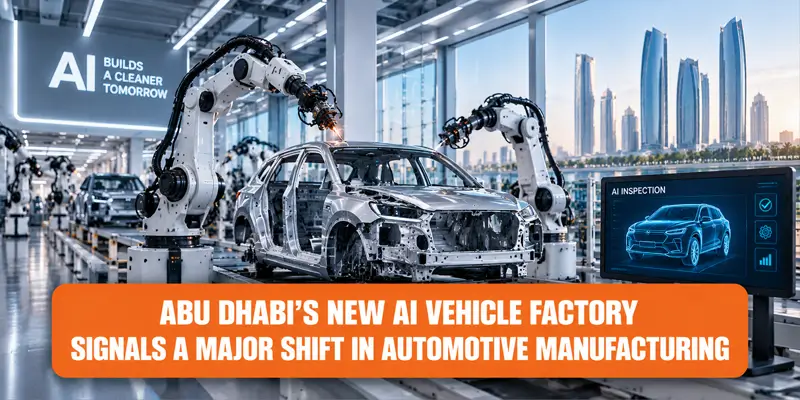

Abu Dhabi is taking another major step towards becoming a global centre for advanced automotive manufacturing with the completion of a new AI-powered vehicle production facility by ROX.

The company has completed its Advanced AI Manufacturing Centre in Abu Dhabi and started local vehicle production, with the first three ROX ADAMAS vehicles carrying the “Made in the Emirates” mark rolling off the production line. The development represents more than a new vehicle assembly operation. It signals a wider shift towards technology-driven manufacturing, local supply chains and high-value automotive production in the UAE.
The facility is supported by the partnership between ROX and the Abu Dhabi Investment Office (ADIO), with the broader objective of localising operations across supply chains, technology and design while contributing to an integrated automotive ecosystem.
So, what does this new facility mean for Abu Dhabi, the UAE automotive industry and the future of vehicle manufacturing?
What Is the New AI Vehicle Factory in Abu Dhabi?
The new facility is ROX’s Advanced AI Manufacturing Centre, designed to combine vehicle production with advanced technologies and a more digitally integrated manufacturing process.
Unlike conventional factories that focus primarily on vehicle assembly, AI-enabled manufacturing can bring artificial intelligence, automation, data analysis and intelligent production systems into different stages of the manufacturing process.
The completion of the facility means vehicles can now carry the “Made in the Emirates” designation, strengthening the UAE’s position as more than simply a market for imported vehicles. It also supports Abu Dhabi’s long-term objective of developing an automotive ecosystem covering production, technology, suppliers, research and after-sales services.
Why Is Abu Dhabi Investing in Automotive Manufacturing?
The development forms part of a much broader industrial strategy. Abu Dhabi has been working to establish itself as a manufacturing and technology hub capable of attracting international companies and supporting high-value industries.
The Emirate’s automotive ambitions extend beyond simply building cars. Earlier plans outlined by ADIO targeted an end-to-end automotive ecosystem covering vehicle production, support industries, research and development, engineering, suppliers and after-sales services.
The wider automotive initiative was projected to contribute Dh100 billion to the UAE economy and create 7,000 highly skilled jobs over 20 years.
This makes the latest AI vehicle factory Abu Dhabi development significant because it fits into a much larger effort to build local industrial capabilities rather than relying exclusively on imports.
How AI Is Changing Car Manufacturing
Artificial intelligence is increasingly becoming an important part of the global automotive manufacturing process. Modern factories can use AI and automation to analyse production data, identify potential quality issues and improve manufacturing efficiency.
In a smart manufacturing environment, machines and production systems can collect large amounts of information. AI can then help identify patterns, optimise processes and support more consistent production.
For the UAE, this approach has an additional advantage: it allows the country’s automotive sector to develop around newer technologies rather than simply replicating traditional manufacturing models.
The AI car manufacturing UAE strategy therefore has the potential to connect vehicle production with robotics, data analytics, smart logistics, connected vehicles and new-energy technologies.
ROX and the Made in the Emirates Push
ROX’s move is particularly important because the first locally produced ADAMAS vehicles have received the “Made in the Emirates” mark.
This provides a visible demonstration of the UAE’s ambition to increase local manufacturing and build products for both domestic and international markets.
ROX has positioned Abu Dhabi as an important part of its global expansion strategy, citing the emirate’s infrastructure, investment environment and strategic location between Asia, Europe and Africa. The company has also been developing partnerships across manufacturing, materials, talent development and after-sales services.
Local production can potentially shorten supply chains, create opportunities for UAE-based suppliers and support the development of specialist automotive capabilities.
Abu Dhabi AI Automotive Factory: More Than Vehicle Assembly
One of the most important aspects of the project is the focus on building an ecosystem around vehicle production.
A successful automotive industry requires much more than a factory. It needs suppliers, engineers, software specialists, technicians, logistics providers, testing facilities and after-sales networks.
Abu Dhabi’s automotive strategy has specifically included R&D and engineering centres, participation from Tier 1 and Tier 2 suppliers and premium original equipment manufacturers. The goal is to develop a value chain covering design, manufacturing and after-sales.
This could create opportunities for companies operating in everything from automotive components and electronics to software, battery technology and vehicle services.
What Makes a Smart Vehicle Factory Different?
A smart vehicle factory UAE model relies heavily on digital systems and automation to improve manufacturing operations.
Instead of treating production as a series of isolated manual tasks, smart factories connect equipment, data and production processes. This can allow manufacturers to monitor operations more closely and respond to problems more quickly.
AI can potentially assist with quality control, predictive maintenance, production planning and resource management. Robotics and automated systems can also handle repetitive manufacturing tasks with greater consistency.
The result is a production environment designed around data and intelligent decision-making rather than traditional manufacturing alone.
The Growing Role of AI Automotive Technology UAE
The automotive industry is undergoing a major transformation. Electric vehicles, connected cars, autonomous driving and software-defined vehicles are changing what consumers expect from automobiles.
The UAE has been positioning itself to participate in this transformation. Abu Dhabi has already established initiatives around smart and autonomous mobility, including its Smart and Autonomous Vehicle Industry (SAVI) cluster.
SAVI was designed to support the testing and development of air, land and sea mobility applications, with dedicated testing environments and an automotive cluster in Abu Dhabi’s Mussafah Industrial Zone.
The new manufacturing facility adds another piece to this ecosystem by connecting advanced mobility technologies with actual vehicle production.
Why the Location Matters
Abu Dhabi’s geographical position is another advantage for automotive manufacturing.
The emirate provides access to regional markets across the Middle East while also offering connections to markets in Africa, Asia and Europe. For manufacturers seeking an export-oriented production base, this geographical position can be strategically valuable.
ROX has specifically highlighted Abu Dhabi’s location between three continents as one of the reasons for choosing the emirate as its global base.
Combined with industrial infrastructure, investment opportunities and government-backed initiatives, the location could help Abu Dhabi develop into a regional manufacturing and export centre.
What Does This Mean for the Abu Dhabi Automotive Industry?
The arrival of AI-driven vehicle production could significantly expand the scope of the Abu Dhabi automotive industry.
Traditionally, automotive markets have been dominated by imported vehicles and established international manufacturing hubs. A growing local production ecosystem could change this dynamic by encouraging manufacturers and suppliers to establish operations within the UAE.
This could create new opportunities for engineering, software development, vehicle testing, industrial automation and technical services.
It could also encourage collaboration between automotive companies, technology firms and educational institutions, helping develop specialised talent for the next generation of mobility.
New Opportunities for Jobs and Skills
Advanced manufacturing requires a different workforce from traditional assembly operations.
An AI-powered automotive facility can create demand for engineers, software developers, robotics specialists, data analysts, technicians and manufacturing professionals.
Abu Dhabi’s automotive strategy has already included initiatives designed to develop local talent. ADIO previously introduced an Automotive AI Curriculum focused on product design, combining AI training with international placements to strengthen local expertise in the mobility sector.
As the sector expands, these skills could become increasingly valuable across the UAE’s wider technology and manufacturing industries.
Could Abu Dhabi Become a Regional Automotive Hub?
The latest development strengthens Abu Dhabi’s case for becoming a regional automotive manufacturing hub, but building a globally competitive industry will require more than a single factory.
A successful ecosystem needs a reliable supply chain, skilled workforce, competitive production capabilities, research and development, testing infrastructure and access to international markets.
Abu Dhabi is already working on several of these areas. The combination of AI manufacturing, smart mobility initiatives, industrial infrastructure and investment programmes provides a foundation for further growth.
ROX has also outlined an ambitious long-term production target of up to 300,000 vehicles annually by 2030, demonstrating the scale of its manufacturing ambitions in the emirate.
How AI Could Shape the Future of UAE-Made Cars
The impact of AI may eventually extend beyond the factory floor. Artificial intelligence is becoming increasingly important in vehicle design, driver assistance, predictive maintenance, connected services and autonomous mobility.
This means the future of UAE-made vehicles could involve a much stronger connection between physical manufacturing and digital technology.
For consumers, this could eventually result in vehicles with more advanced connectivity, smarter software and greater integration with intelligent transport infrastructure.
For manufacturers, AI could provide tools to improve production efficiency and adapt vehicles to specific regional requirements.
What Does This Mean for UAE Drivers?
For motorists, the immediate impact may be relatively limited because the new facility is primarily an industrial development. However, the long-term implications could be significant.
Greater local production can potentially provide more vehicle choices, strengthen after-sales ecosystems and encourage manufacturers to develop products specifically for regional conditions.
It could also support the growth of automotive technology companies and service providers, creating a more diverse UAE automotive market.
As local manufacturing expands, motorists may increasingly encounter vehicles carrying the “Made in the Emirates” mark alongside established international brands.
Quick Look: Abu Dhabi's AI Automotive Manufacturing Shift
ROX has completed its Advanced AI Manufacturing Centre in Abu Dhabi and begun local production, with the first three ADAMAS vehicles carrying the “Made in the Emirates” mark. The facility is supported by the Abu Dhabi Investment Office and forms part of a wider strategy to localise vehicle production, technology and supply chains.
The project also complements Abu Dhabi’s broader efforts in smart mobility, AI, autonomous vehicles and advanced manufacturing.
Final Thoughts
The launch of the AI vehicle factory Abu Dhabi facility represents an important milestone for the UAE’s automotive ambitions. The significance goes beyond the production of a new batch of vehicles. It demonstrates how Abu Dhabi is bringing artificial intelligence, advanced manufacturing and local industrial development together.
With the first ROX ADAMAS vehicles now carrying the “Made in the Emirates” mark, the UAE is moving another step closer to establishing a complete automotive ecosystem capable of supporting production, technology, talent and exports.
As AI, electric mobility and autonomous driving continue to reshape the global automotive industry, Abu Dhabi’s decision to invest in smart manufacturing could give the emirate an opportunity to play a larger role in the future of mobility.
Stay Updated with Miss Auto
Want to stay informed about the latest developments shaping the UAE automotive industry?
Miss Auto brings you the latest vehicle launches, automotive technology, UAE manufacturing developments, EV trends, smart mobility updates and industry news. From the latest AI automotive technology UAE developments to practical car guides, Miss Auto helps readers stay ahead of the changing world of mobility.
Follow Miss Auto for more automotive insights, UAE industry updates and the latest developments shaping the future of driving.
FAQs
What is the new AI vehicle factory in Abu Dhabi?
It is ROX’s Advanced AI Manufacturing Centre, which has begun local vehicle production in Abu Dhabi. The first three ROX ADAMAS vehicles produced at the facility carry the “Made in the Emirates” mark.
Why is the Abu Dhabi AI automotive factory important?
The facility represents a move towards advanced, technology-driven vehicle manufacturing in the UAE and supports Abu Dhabi’s wider goal of developing an integrated automotive ecosystem.
Which vehicles are being produced in Abu Dhabi?
The first locally produced vehicles from the facility are ROX ADAMAS models, according to Gulf News.
How does AI improve vehicle manufacturing?
AI can support areas such as quality control, predictive maintenance, production planning, data analysis and process optimisation, helping manufacturers create more efficient smart factories.
Could Abu Dhabi become a major automotive manufacturing hub?
Abu Dhabi is developing an automotive ecosystem that includes manufacturing, R&D, suppliers, smart mobility and technology. The success of the wider industry will depend on continued investment, skilled talent, supply chains and international market access.
What is the “Made in the Emirates” mark?
It identifies products manufactured locally in the UAE. The first three ROX ADAMAS vehicles produced at the new Abu Dhabi facility have received the mark.
How does this support the UAE automotive industry?
Local vehicle production can encourage investment in suppliers, engineering, technology, logistics and after-sales services while creating opportunities for specialised automotive and AI-related talent.


