



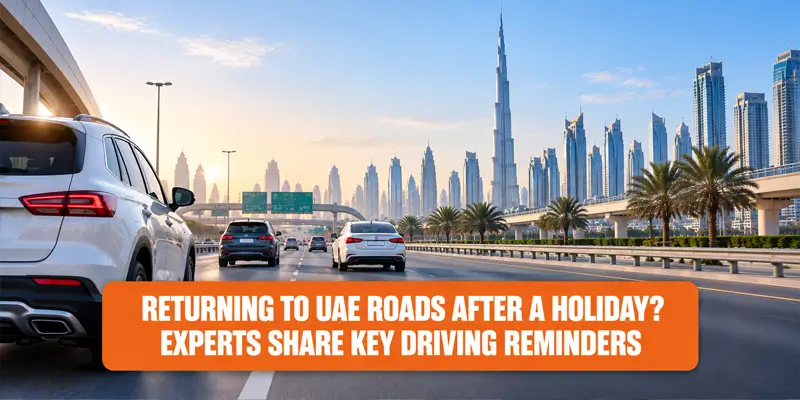

Coming home after a holiday can mean getting back into familiar routines almost immediately. For motorists, however, stepping out of the airport and getting behind the wheel is not simply about continuing where the journey left off. After spending days or weeks driving in another country or not driving at all drivers may need a little time to readjust to returning to UAE roads.

Fatigue from travel, heavy luggage, busy roads and differences in driving habits can all affect concentration. Experts have highlighted the importance of allowing yourself time to settle back into UAE traffic conditions rather than rushing into the first journey home.
The UAE has a well-established road network and clearly enforced traffic regulations. For returning motorists, refreshing some basic rules can help prevent unnecessary mistakes, fines and, most importantly, accidents.
Driving Reminders UAE Motorists Should Remember
One of the most important driving reminders UAE motorists should keep in mind after returning from a holiday is to avoid assuming that familiar roads require less attention.
Even if you have driven the same route hundreds of times, tiredness can affect reaction time and judgement. Airport journeys can also involve unfamiliar traffic patterns, additional luggage and late-night or early-morning driving.
The safest approach is to treat the first few drives as a gradual return to your normal routine. Give yourself more time, avoid rushing and concentrate fully on the road.
Fatigue Can Make the First Drive Riskier
Jet lag and travel fatigue can make drivers less alert. While there is no separate UAE traffic fine simply for being jet-lagged, driving in a manner that endangers yourself or others can result in serious penalties, including a Dh2,000 fine, 23 black points and vehicle impoundment for certain light-vehicle offences.
If you have arrived after a long flight and feel extremely tired, consider resting before driving. If possible, arrange alternative transportation or allow yourself enough time to recover.
Being behind the wheel while struggling to stay alert can be dangerous even when the road appears relatively quiet.
Check Your Luggage Before Leaving the Airport
Returning from a holiday often means returning with considerably more luggage than you had when you left. Suitcases, shopping bags and other items need to be stored securely.
Large bags should not obstruct the driver’s rear visibility, interfere with passengers or move around the cabin. Heavy luggage should also be distributed carefully rather than piled in a way that affects the vehicle’s balance.
Overloading a light vehicle or carrying cargo outside permitted limits can attract a Dh500 fine and four black points. A falling or leaking load can also result in a Dh500 fine.
Taking a few minutes to organise luggage before starting the journey is therefore both a safety measure and a way to avoid an unnecessary penalty.
Give Yourself More Following Distance
After spending time away from UAE roads, motorists may need to readjust to local traffic speeds and driving conditions. One of the easiest ways to make this transition safer is to maintain a comfortable distance from the vehicle ahead.
Following too closely reduces the amount of time available to react if the vehicle ahead brakes suddenly. This becomes particularly important on highways and busy urban roads where traffic can change speed quickly.
Failing to maintain a safe following distance carries a Dh400 fine and four black points.
For your first few drives after returning, leaving slightly more space can give you additional reaction time and help you settle back into UAE traffic.
Don't Let Your Phone Distract You
A holiday may involve checking maps, messages, photos and travel updates on your phone. But once you are driving, the device should be put away.
Using a mobile phone or becoming distracted while driving can result in a Dh800 fine and four black points.
Drivers returning after a holiday may be tempted to check flight details, messages from family or navigation information while moving. Set your route before starting, use hands-free navigation where appropriate and pull over safely if you need to deal with your phone.
No message is worth taking your attention away from the road.
Don't Mistake Quiet Roads for Permission to Speed
Late-night and early-morning airport journeys can sometimes involve relatively empty roads. That does not mean speed limits no longer matter.
Speed cameras and traffic enforcement continue to apply regardless of how busy a road appears. Speeding fines in the UAE can start from Dh300 for exceeding the limit by up to 20km/h and increase significantly for more serious violations.
Returning motorists should therefore resist the temptation to make up time after a delayed flight or long journey by driving faster than permitted.
UAE Road Safety Tips: A Quick Infographic
| Situation | What Drivers Should Do | Why It Matters |
| Feeling tired after a flight | Rest before driving | Improves concentration and reaction time |
| Heavy holiday luggage | Secure bags and avoid overloading | Prevents visibility and stability issues |
| Busy highways | Maintain a safe following distance | Gives more time to react |
| Phone notifications | Keep the phone away | Reduces distraction |
| Quiet airport roads | Follow posted speed limits | Avoids speeding violations |
| First drive after returning | Drive calmly and avoid rushing | Helps readjust to UAE traffic |
| Vehicle warning or issue | Stop safely and seek assistance | Prevents further risk |
UAE Driving Safety Tips for Families
Families returning from holidays often face an additional challenge: children, luggage and tired passengers can make the first drive more distracting.
Before setting off, ensure everyone is seated properly and wearing a seat belt. Children should be secured using the appropriate restraint system. Loose objects should also be stored safely instead of being left where they could become projectiles during sudden braking.
Parents should avoid turning around repeatedly to attend to children while driving. If something needs immediate attention, find a safe location to stop rather than attempting to deal with it while the vehicle is moving.
These simple precautions form an important part of a wider UAE road safety guide for families.
Check Your Vehicle Before Returning to Daily Driving
If your car has been parked for an extended period while you were travelling, give it a quick inspection before resuming normal driving.
Check the tyres for visible damage and make sure they are properly inflated. Look at the fuel level, engine warning lights and fluid levels, and check that the lights and windscreen wipers are functioning correctly.
Tyre condition is particularly important in the UAE’s climate. Authorities have repeatedly warned motorists about the risks associated with damaged, worn or unsuitable tyres. Driving with damaged tyres can result in a Dh500 fine, four black points and vehicle impoundment for one week.
If the vehicle has been unused for a long period, consider having it inspected before undertaking a long journey.
Readjust to UAE Traffic Patterns
Driving habits can differ significantly between countries. After spending time abroad, motorists may need to consciously readjust to lane discipline, speed differences, overtaking practices and local traffic behaviour.
This is particularly relevant for drivers moving between Dubai, Abu Dhabi, Sharjah and other emirates, where traffic volumes and road layouts can vary considerably.
Rather than trying to match the pace of other drivers, focus on maintaining a safe speed, using indicators correctly and staying within your lane.
What If Your Vehicle Breaks Down?
A vehicle problem after returning from a holiday can be particularly stressful, especially on a busy road. If your vehicle breaks down, move away from the traffic lane where safely possible and switch on the hazard lights to warn other motorists.
Avoid standing on the roadway or attempting repairs in a dangerous location. If necessary, exit the vehicle from the side away from traffic and move to a safer location behind a barrier or guardrail.
Motorists should also keep emergency assistance details accessible so they can request help without unnecessarily remaining exposed to traffic.
Safe Driving Dubai: Small Habits Make a Difference
For motorists in Dubai, safe driving is not only about avoiding fines. It is about developing habits that reduce the possibility of an accident.
Using indicators before changing lanes, checking blind spots, maintaining a safe distance and remaining patient in congestion can all contribute to safer journeys.
Drivers should also avoid unnecessary aggressive manoeuvres when traffic slows. A few minutes saved by sudden lane changes or speeding is rarely worth the additional risk.
The same principle applies when travelling between emirates. Give yourself sufficient time so that reaching your destination does not become more important than reaching it safely.
Post Holiday Driving UAE: A Simple Reset
The first journey after a holiday is a good opportunity to reset your driving habits. Instead of immediately returning to rushed commutes, start by giving yourself additional time and paying closer attention to your surroundings.
Check the vehicle, secure your luggage, plan your route and ensure that everyone is properly seated before leaving. Once on the road, concentrate on traffic rather than your phone or other distractions.
This simple reset can make the transition back to everyday UAE driving considerably smoother.
Quick Look: Returning to UAE Roads
The most important UAE road safety tips for returning motorists are straightforward: avoid driving while excessively tired, secure holiday luggage, maintain a safe following distance, keep your phone away, follow speed limits and check your vehicle before returning to regular driving.
These habits can help motorists readjust to local roads while reducing the risk of accidents and traffic violations.
Final Verdicts
Returning to UAE roads after a holiday should be treated as a gradual transition rather than an immediate return to normal driving habits.
Fatigue, unfamiliar traffic patterns, heavy luggage and distractions can all affect a driver’s concentration. By taking a few extra minutes to rest, check the vehicle, secure luggage and plan the journey, motorists can reduce unnecessary risks.
The UAE’s traffic rules are designed to protect everyone on the road, and following them consistently is one of the simplest ways to make daily journeys safer. Whether you are driving in Dubai, Abu Dhabi or another emirate, patience, awareness and preparation remain essential.
Stay Updated with Miss Auto
Want more practical UAE road safety tips, traffic updates and automotive advice?
Miss Auto keeps UAE motorists informed with useful driving guides, road-safety updates, vehicle news, maintenance advice and the latest developments across the automotive world. From driving reminders UAE motorists need to know to new vehicle launches and road updates, Miss Auto helps you stay informed wherever your journey takes you.
Follow Miss Auto for more practical automotive insights and smarter driving tips across the UAE.
FAQs
What should I do before driving after returning from a holiday?
Rest if you are tired, check your vehicle, secure your luggage, plan your route and make sure everyone is properly buckled up before starting the journey.
Can fatigue lead to a traffic fine in the UAE?
There is no specific fine for being jet-lagged, but dangerous driving can result in serious penalties. Drivers should avoid driving when excessively fatigued.
What is the fine for following another vehicle too closely?
Failing to maintain a safe following distance can result in a Dh400 fine and four black points.
Can holiday luggage cause a traffic violation?
Yes. Overloading a light vehicle or carrying cargo in violation of permitted limits can result in a Dh500 fine and four black points. Luggage should always be securely stored.
What are the most important UAE road safety tips?
Stay alert, follow speed limits, maintain a safe distance, avoid mobile-phone use, wear seat belts, secure luggage and never drive when excessively tired.


