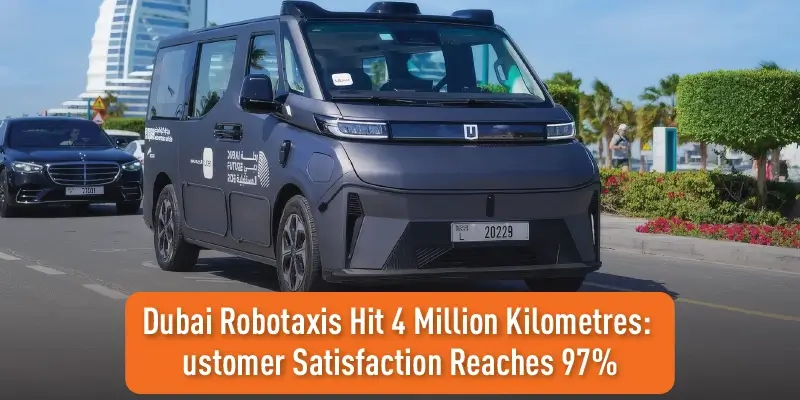
Dubai is moving another step closer to a future where driverless mobility becomes part of everyday urban transportation. The emirate’s Dubai robotaxis have now travelled more than 4 million kilometres and completed 7,613 passenger trips since operations began, marking a major milestone for the city’s autonomous transport programme.

The latest figures also reveal strong public acceptance, with robotaxi customer satisfaction reaching 97%. The Roads and Transport Authority (RTA) said the progress demonstrates growing confidence in autonomous mobility and supports Dubai’s long-term ambition to make 25% of all transportation trips autonomous by 2030.

For residents and visitors, the development signals that autonomous taxis are gradually moving beyond technology demonstrations and controlled trials towards a more practical role within Dubai’s wider transport network.

What Is the Latest Update on Dubai Robotaxis?

Dubai’s robotaxi programme has crossed the 4-million-kilometre mark, demonstrating the amount of real-world operational experience accumulated by autonomous vehicles in the emirate.

According to RTA, the current robotaxi fleet consists of 144 vehicles, of which 48 are actively operating. The active fleet completes approximately 50 trips every day, while the overall programme has already recorded 7,613 passenger journeys.

Perhaps the most significant figure for everyday passengers is the 97% customer satisfaction rate.

High satisfaction indicates that passengers are increasingly comfortable with the experience of travelling in autonomous vehicles. It also provides an important indication that Dubai’s approach is not focused only on deploying technology but also on creating a reliable and acceptable customer experience.

Why Is the 4 Million-Kilometre Milestone Important?

The distance travelled by autonomous vehicles is more than simply a headline figure.

Every kilometre provides an opportunity to collect operational experience, assess vehicle behaviour and refine autonomous driving systems under real-world conditions.

Dubai is testing these vehicles in designated areas and actual traffic environments rather than relying entirely on controlled testing facilities. This allows operators and authorities to evaluate how autonomous systems respond to everyday road conditions and different situations.

The accumulated Dubai robotaxi kilometres therefore represent an extensive operational base for improving safety, reliability and passenger experience.

Real-World Testing

Autonomous driving technology needs to perform in unpredictable environments. Traffic patterns, road users, intersections and changing road conditions can all present different challenges.

Operating robotaxis in defined areas allows companies to gather practical data while authorities monitor the technology’s performance.

Building Passenger Confidence

Passenger adoption is another important part of autonomous transport.

The 97% satisfaction figure suggests that people using the service are responding positively to the experience. This could become increasingly important as Dubai prepares to expand autonomous mobility.

Preparing for Wider Deployment

The accumulated operating experience can help companies and regulators identify areas that need improvement before autonomous services are expanded to additional locations.

What Is the Robotaxi Customer Satisfaction Rate in Dubai?

The current robotaxi customer satisfaction rate stands at 97%, according to RTA.

This is one of the strongest indicators of public acceptance of the programme. Rather than measuring only technical performance, customer satisfaction provides insight into how passengers perceive the actual travel experience.

For autonomous transportation to become a mainstream mobility option, passengers need to feel comfortable using vehicles without conventional drivers.

The high satisfaction figure suggests that Dubai’s robotaxi programme is making progress in building that confidence.

How Are Dubai Autonomous Taxis Being Tested?

Dubai is taking a phased approach to autonomous taxi deployment.

Instead of immediately introducing a large fleet of fully driverless vehicles throughout the city, the programme is being developed through defined operational areas. These areas allow the technology to be tested under real-world traffic conditions while operators and authorities assess safety, reliability and operational readiness.

The programme is also gradually moving from vehicles operating with safety drivers towards fully driverless transportation.

This staged approach is important because autonomous mobility requires more than simply installing sensors and software in a vehicle. The technology must demonstrate that it can operate reliably within an actual urban transport ecosystem.

Which Companies Are Developing Robotaxis in Dubai?

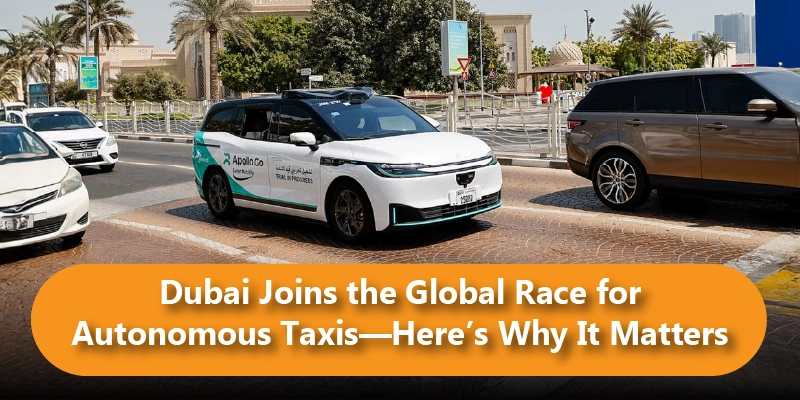
RTA is working with three major autonomous mobility companies: Baidu’s Apollo Go, WeRide and Pony.ai.

These partnerships combine autonomous-driving technology with fleet-operation expertise and are intended to support the expansion of driverless taxi services across Dubai.

Each partnership contributes to Dubai’s broader effort to establish an autonomous transport ecosystem rather than relying on a single technology provider.

Baidu Apollo Go

Baidu’s Apollo Go is among the companies involved in Dubai’s robotaxi programme. Fully driverless Apollo Go vehicles are also available to riders through the Uber platform in Dubai, with New Horizon Luxury Transport operating the fleet.

WeRide

WeRide is another major autonomous-driving partner working with RTA to develop robotaxi services and support the emirate’s autonomous mobility ambitions.

Pony.ai

Pony.ai is also collaborating with RTA as part of the programme to develop and expand autonomous taxi services.

Together, these partnerships are helping Dubai create a technology ecosystem capable of supporting the next generation of urban mobility.

What Does Robotaxi Dubai 2026 Mean for Passengers?

The robotaxi Dubai 2026 milestone shows that autonomous transport is becoming increasingly visible in everyday mobility.

For passengers, the concept is relatively simple: instead of a conventional taxi driver controlling the vehicle, autonomous systems handle driving tasks while the passenger travels to the destination.

However, the technology behind that experience is significantly more complex.

Vehicles use autonomous driving systems to perceive their surroundings, understand road conditions and make driving decisions. Continuous testing and operational experience are therefore essential for improving performance.

As the programme develops, passengers could eventually have access to more autonomous taxi options across a wider portion of Dubai.

Why Is Dubai Investing in Self-Driving Taxis?

Dubai’s growing population and mobility demand are among the factors supporting the development of autonomous transport.

The emirate’s population has surpassed 4 million, while public transport, shared mobility services and taxis carried around 348 million riders during the first half of 2026. Average daily ridership reached approximately 1.9 million.

This creates a strong demand for efficient, technology-enabled mobility solutions.

Self driving taxis in the UAE initiatives can potentially complement existing transport modes rather than replace them entirely.

Robotaxis can become another option alongside Dubai Metro, buses, conventional taxis, ride-hailing services and other shared mobility solutions.

How Do Robotaxis Fit Into Dubai’s Transport Strategy?

Dubai’s autonomous transport programme forms part of a much larger vision for smart mobility.

RTA has set a target of making 25% of all transportation trips autonomous by 2030. The progress made by robotaxis contributes directly to this objective.

Achieving this target will require more than robotaxis alone. Autonomous public transport, aerial mobility and other driverless transportation technologies can also contribute to the broader strategy.

Robotaxis are particularly important because taxis are already a familiar part of daily transportation. Introducing autonomy into this category could provide a practical route for passengers to experience driverless mobility.

What Makes Dubai’s Autonomous Driving Approach Different?

One of the notable aspects of autonomous driving in Dubai initiatives is the emphasis on gradual deployment.

Dubai is not simply introducing autonomous vehicles and expecting immediate mass adoption. Instead, authorities and technology companies are building operational experience step by step.

This approach allows them to:

This combination of technology development, regulation and real-world testing is essential for creating a sustainable autonomous mobility network.

Are Dubai Robotaxis Fully Driverless?

The transition towards fully driverless transportation is happening gradually.

The programme has included vehicles operating with safety drivers while technology is tested and validated. At the same time, Dubai is moving towards fully driverless services in selected operational areas.

Baidu’s fully driverless Apollo Go vehicles are already available to riders through Uber in Dubai, demonstrating that the city has moved beyond purely experimental autonomous taxi operations.

However, availability remains dependent on designated service areas and the specific operational framework.

What Could Robotaxis Mean for Dubai’s Future?

The growth of robotaxis could have a significant impact on how people move around Dubai.

If autonomous vehicles are eventually deployed at a larger scale, they could become an important part of the city’s mobility mix.

Potential advantages include:

Greater Mobility Availability

Autonomous vehicles could provide additional transportation capacity as demand grows.

Technology-Driven Operations

Connected autonomous fleets can be integrated into digital mobility systems, allowing technology to play a greater role in fleet management and passenger services.

New Passenger Experiences

For many residents and visitors, a driverless taxi could become a normal transportation option rather than a novelty.

Support for Smart-City Goals

The expansion of autonomous transportation aligns with Dubai’s broader ambition to develop smart, technology-enabled infrastructure.

What Does the 97% Satisfaction Rate Tell Us?

The 97% customer satisfaction figure is arguably as important as the 4-million-kilometre milestone.

Technology can demonstrate impressive technical capabilities, but widespread adoption ultimately depends on whether people are willing to use it.

A high satisfaction rate suggests that passengers who have experienced Dubai’s robotaxi services are responding positively to the technology.

This could help create a foundation for future expansion. As more people experience autonomous taxis, familiarity with driverless transportation may increase.

What Happens Next for Dubai Robotaxis?

The next stage is likely to focus on expanding operational coverage, increasing the number of vehicles and progressing towards more fully driverless services.

RTA is continuing to work with Baidu Apollo Go, WeRide and Pony.ai as part of its roadmap for autonomous taxi services.

The accumulated 4 million kilometres and thousands of passenger trips provide valuable operational experience as Dubai prepares for the next phase.

The goal is not simply to operate robotaxis in a limited area but to gradually integrate autonomous mobility into the emirate’s wider transport network.

Final Thoughts

Dubai Robotaxis Reach 4 Million Kilometres

Dubai’s robotaxi programme has surpassed 4 million kilometres and 7,613 passenger trips, achieving 97% customer satisfaction. With 144 vehicles and partnerships with Baidu Apollo Go, WeRide and Pony.ai, Dubai is moving closer to its goal of making 25% of transport trips autonomous by 2030, bringing driverless mobility closer to everyday travel.

Stay Updated with Miss Auto

Stay informed with Miss Auto for the latest UAE automotive and mobility news, Dubai transport developments, autonomous vehicles, EV updates, RTA announcements, new vehicle launches, technology-driven mobility trends, car buying guides and robotaxi Dubai 2026 updates.

FAQs

How many kilometres have Dubai robotaxis travelled?

Dubai’s robotaxi programme has travelled more than 4 million kilometres since operations began and completed 7,613 passenger trips.

The current customer satisfaction rate is 97%, indicating strong passenger acceptance of the autonomous taxi service.

The robotaxi fleet currently consists of 144 vehicles, with 48 in active operation. The active fleet completes approximately 50 trips per day.

RTA is working with Baidu’s Apollo Go, WeRide and Pony.ai to develop and expand autonomous taxi services in Dubai.

Yes. Fully driverless Baidu Apollo Go vehicles are available to riders through the Uber platform in Dubai in selected areas, with New Horizon Luxury Transport operating the fleet.

Dubai aims to make 25% of all transportation trips autonomous by 2030. The robotaxi programme is one component supporting this wider autonomous mobility strategy.

Author

  • Max Wheeler

    Max Wheeler is a automotive writer known for insightful car reviews, maintenance guides, and industry updates. His goal is to help drivers stay informed and confident on the road.

Shares: