


UAE Fuel Prices October 2026: Petrol Hike and New Rates Explained
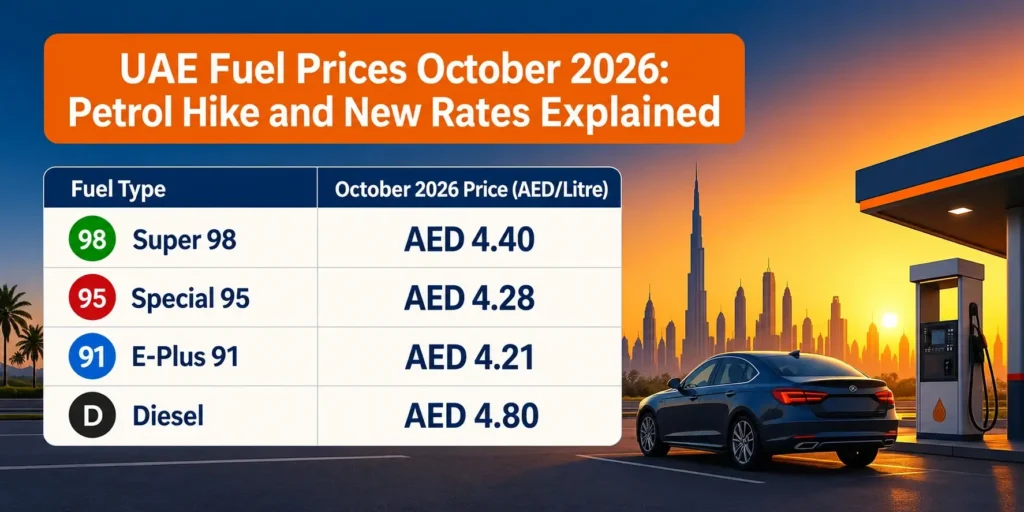
UAE Fuel Prices October 2026: Petrol Hike and New Rates The UAE has officially announced the UAE fuel prices October 2026, giving motorists, businesses and fleet operators the latest monthly fuel price update across the Emirates. The new rates will take effect from 1 October 2026, with all petrol grades and diesel prices increasing compared with September.
According to the latest announcement, Super 98, Special 95 and E-Plus 91 petrol prices have each increased, while diesel has also recorded a significant rise. E-Plus 91 has seen the largest percentage increase among the petrol categories, rising by 16.6% compared with September.
Whether you’re searching for the latest petrol prices UAE October 2026, UAE petrol price hike, new fuel rates UAE 2026, or Dubai petrol prices October 2026, here’s everything you need to know.
UAE Fuel Prices October 2026 Announced
The UAE Fuel Price Committee has announced the latest petrol and diesel prices for October 2026, with the revised rates becoming effective from October 1.
All fuel categories have increased compared with September. Super 98 petrol will rise from AED 3.80 to AED 4.40 per litre, while Special 95 will increase from AED 3.69 to AED 4.28. E-Plus 91 will move from AED 3.61 to AED 4.21 per litre.
Diesel will also increase from AED 4.30 to AED 4.80 per litre.
The latest adjustment means motorists will face higher refuelling costs during October, while businesses operating commercial and diesel-powered fleets may also need to account for increased fuel expenditure.
Official UAE Fuel Price List for October 2026
The newly announced UAE fuel prices October 2026 are:
| Fuel Type | October 2026 Price (AED/Litre) |
| Super 98 | AED 4.40 |
| Special 95 | AED 4.28 |
| E-Plus 91 | AED 4.21 |
| Diesel | AED 4.80 |
These new rates will apply from 1 October 2026.
How October Prices Compare with September
Compared with September 2026, all three major petrol grades have increased by between AED 0.59 and AED 0.60 per litre. Diesel has increased by AED 0.50 per litre.
| Fuel Type | September 2026 | October 2026 | Change |
| Super 98 | AED 3.80 | AED 4.40 | AED 0.60 |
| Special 95 | AED 3.69 | AED 4.28 | AED 0.59 |
| E-Plus 91 | AED 3.61 | AED 4.21 | AED 0.60 |
| Diesel | AED 4.30 | AED 4.80 | AED 0.50 |
The percentage increases are 15.8% for Super 98, 16% for Special 95, 16.6% for E-Plus 91 and 11.6% for diesel.
UAE Petrol Prices October 2026: What Has Changed?
The petrol prices UAE October 2026 show a significant increase across all three petrol categories.
Super 98 petrol has increased from AED 3.80 to AED 4.40 per litre. Special 95 has moved from AED 3.69 to AED 4.28, while E-Plus 91 has risen from AED 3.61 to AED 4.21 per litre.
The increase means motorists will pay more each time they refuel. The actual impact on monthly expenses will depend on factors such as vehicle fuel efficiency, daily mileage, tank capacity and how frequently the vehicle is used.
Drivers covering long distances every day may notice the change more clearly in their monthly transportation expenses.
UAE Diesel Prices October 2026 See Another Rise
The UAE diesel prices October 2026 have also increased.
Diesel will cost AED 4.80 per litre in October, compared with AED 4.30 in September. This represents an increase of AED 0.50 per litre, or approximately 11.6%.
The increase is particularly relevant to businesses and operators that depend heavily on diesel-powered vehicles.
Logistics companies, delivery services, freight operators, construction businesses and commercial fleet operators may need to factor the higher diesel price into their monthly operating budgets.
Why Have UAE Fuel Prices Increased?
The UAE’s fuel prices are reviewed monthly in line with prevailing trends in global energy markets. The UAE Fuel Price Committee reviews retail petrol and diesel rates at the close of each month.
International crude oil prices, refined fuel markets, global supply conditions, geopolitical developments and changes affecting regional oil flows can influence energy prices.
Recent global oil-market volatility has also been linked to uncertainty surrounding regional energy supplies and developments affecting crude exports.
For the UAE, these international market movements can eventually influence the retail prices motorists pay at fuel stations.
What the New Fuel Rates UAE Mean for Motorists
The latest new fuel rates UAE 2026 announcement means motorists should expect higher refuelling costs throughout October.
For example, filling a 50-litre tank with Special 95 at the October rate would cost approximately AED 214.
At the September rate of AED 3.69 per litre, the same 50-litre fill would have cost AED 184.50.
That means the same 50-litre tank requires approximately AED 29.50 more in October.
For motorists who refuel several times each month, these additional costs can gradually increase monthly transportation expenses.
Impact on UAE Motorists
The October fuel price adjustment will affect private vehicle owners, daily commuters and families who rely on cars for regular travel.
Drivers travelling frequently between Emirates may be particularly conscious of fuel consumption, especially when covering longer distances.
While motorists cannot control monthly fuel rates, they can take practical steps to improve fuel efficiency and reduce unnecessary fuel consumption.
Maintaining the correct tyre pressure, avoiding unnecessary idling, accelerating smoothly and following the recommended servicing schedule can all help improve fuel economy.
Dubai Petrol Prices October 2026: What Drivers Should Know
The Dubai petrol prices October 2026 will follow the UAE’s announced October fuel rates. Drivers in Dubai will therefore see the revised petrol prices from October 1.
For motorists who depend on their vehicles for daily commuting, school runs, business travel and long-distance journeys, monitoring monthly fuel prices can help with household and transportation budgeting.
At the same time, proper vehicle maintenance can help ensure that fuel is used efficiently.
Issues such as underinflated tyres, clogged air filters, poor engine performance and overdue maintenance can affect fuel consumption and increase running costs.
Businesses Continue to Monitor Fuel Costs
Fuel costs remain an important consideration for businesses that operate vehicle fleets.
Logistics companies, courier services, delivery operators, transportation providers, construction companies and other commercial businesses can be particularly sensitive to changes in fuel prices.
The AED 0.50-per-litre increase in diesel may have a noticeable effect on businesses operating larger diesel-powered fleets.
Fleet operators can therefore focus on route optimisation, preventive maintenance, driver efficiency and fuel monitoring to manage operating expenses.
How Can Drivers Reduce Fuel Consumption?
Although fuel prices change regularly, motorists can take several practical steps to improve fuel efficiency.
- Maintain the vehicle's recommended tyre pressure.
- Follow the manufacturer's recommended servicing schedule.
- Avoid unnecessary engine idling.
- Accelerate and brake smoothly.
- Remove unnecessary weight from the vehicle.
- Keep air filters and other service components in good condition.
- Plan routes efficiently to avoid unnecessary driving.
- Address engine or performance issues at an early stage.
- Avoid aggressive acceleration and sudden braking.
- Combine multiple short trips where practical.
Regular maintenance can help a vehicle operate efficiently while reducing the risk of unexpected repairs.
Long-Term UAE Fuel and Automotive Trends
The UAE’s automotive sector continues to evolve as the country invests in sustainable mobility, electric vehicles, smart transportation and modern infrastructure.
While petrol and diesel vehicles remain an important part of the country’s transportation network, electric vehicle adoption and charging infrastructure are also developing.
These changes could influence future mobility patterns, vehicle ownership and fuel demand across the Emirates.
For conventional vehicle owners, however, fuel efficiency and preventive maintenance will remain important factors in managing running costs.
Final Verdict
The latest UAE fuel prices October 2026 announcement brings higher petrol and diesel rates from October 1.
Super 98 has increased to AED 4.40 per litre, Special 95 to AED 4.28 and E-Plus 91 to AED 4.21. Diesel has also increased to AED 4.80 per litre.
For private motorists, the increase means higher refuelling expenses, while businesses operating commercial and diesel-powered fleets may face additional pressure on operating costs.
Keeping track of the latest fuel rates UAE 2026 updates can help residents and businesses plan their monthly transportation budgets more effectively.
At the same time, regular servicing, efficient driving, correct tyre pressure and proper vehicle maintenance can help motorists get better value from every litre of fuel.
Stay connected with Miss Auto UAE for the latest UAE automotive news, fuel price updates, vehicle maintenance advice, EV developments and transportation insights.
Frequently Asked Questions
What are the UAE petrol and diesel prices for October 2026?
The official October rates are AED 4.40 for Super 98, AED 4.28 for Special 95, AED 4.21 for E-Plus 91 and AED 4.80 per litre for diesel.
When do the October 2026 fuel prices take effect?
The new UAE fuel rates will take effect from 1 October 2026.
How much have petrol prices increased in October 2026?
Super 98 has increased by AED 0.60 per litre, Special 95 by AED 0.59 and E-Plus 91 by AED 0.60 compared with September 2026.
How much has diesel increased in October 2026?
Diesel has increased from AED 4.30 to AED 4.80 per litre, representing an increase of AED 0.50 per litre or approximately 11.6%.
Are fuel prices the same across the UAE?
The announced UAE fuel rates apply across the Emirates, with the new October prices effective from October 1, 2026.
How can drivers reduce fuel consumption?
Regular vehicle maintenance, correct tyre pressure, smooth driving, avoiding unnecessary idling, reducing excess vehicle weight and efficient route planning can help improve fuel economy and reduce overall fuel consumption.