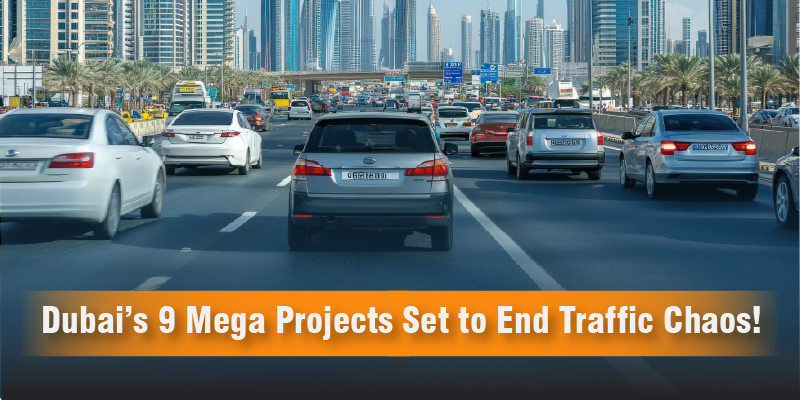

If you’ve ever been stuck on Sheikh Zayed Road during peak hours, you know how precious every minute of your time is. But change is coming — and it’s big. Dubai is rolling out 9 mega transport projects that together promise to reshape daily commutes, decongest roads, and leap into a smarter, more connected future. Whether you drive daily or just care about Dubai traffic updates, these initiatives will touch your life — and soon.
Here’s a look at the nine transformational projects driving Dubai’s future, and what they mean for its road infrastructure and your daily drive.
1. Massive National Road Expansion
At the heart of the plan is a Dh 170 billion national transport package, announced by the UAE’s Ministry of Energy and Infrastructure.
- Emirates Road will be widened to 10 lanes, boosting capacity by ~65% and potentially cutting travel time by 45%.
- Sheikh Mohammed bin Zayed Road is also being expanded to 10 lanes, increasing its capacity by 45%.
- Etihad Road gets six new lanes (three each way), raising it to a 12-lane powerhouse with a capacity uplift of ~60%.
These upgrades, part of long-term RTA Dubai projects, will not only improve inter-emirate connectivity but also reduce congestion for drivers in Dubai — especially those commuting across emirates.
2. The Dubai Loop — Elon Musk’s Underground Network
Imagine skipping above-ground traffic entirely. That’s the dream that the Dubai Loop, built by Elon Musk’s Boring Company, aims to deliver.
- Scheduled to begin in Q2 2026, this underground, high-speed tunnel network connects major districts.
- It’s designed to be weather-resilient, punctual, and safer than surface travel — Musk likens it to “wormhole-like travel.”
This is not just a novelty — it’s part of Dubai’s larger vision to reimagine Dubai road infrastructure by moving part of the transport flow underground.
3. Flying Taxis by 2026
Dubai is going vertical. By 2026, the city aims to launch a fully operational commercial eVTOL (electric Vertical Take-Off and Landing) taxi service developed by Joby Aviation in partnership with the RTA.
- Each aircraft can carry 4 passengers + pilot, travelling at over 300 km/h.
- Vertiports (landing/takeoff hubs) are already being built — for example, one at Dubai International Airport.
- This mode could dramatically slash travel times for journeys — e.g., between Abu Dhabi, Fujairah, or downtown Dubai.
Flying taxis represent a major piece of Dubai’s transport mega projects, aiming to relieve ground traffic and offer a futuristic, efficient travel option.
4. Etihad Rail Passenger Services
Your next inter-emirate commute could be a train ride. The Etihad Rail network is expected to start passenger services by 2026, offering a fast, comfortable, and high-capacity alternative to driving.
- Trains will carry up to 400 passengers per trip.
- High-speed options are being planned: for instance, a route that could link Abu Dhabi and Dubai at speeds up to 350 km/h, reducing the trip to just 30 minutes.
- By diverting long-distance traffic from highways to rails, this becomes a major lever in Dubai traffic improvement 2026 and beyond.
5. Dubai Metro Blue Line Expansion
Public transport is getting a boost too. The Dubai Metro Blue Line is being expanded significantly.
- Two main routes are planned: 21 km (Al Khor ↔ Academic City) and 9 km (Centrepoint ↔ International City).
- It will integrate with existing Red and Green Lines and link to Dubai International Airport.
- This line is expected to carry 46,000 passengers per hour, and daily ridership could hit 200,000 by 2030 (rising to 320,000 by 2040).
- According to Gulf News, it could reduce congestion by 20%.
This expansion is one of the key RTA Dubai projects that supports sustainable mobility and takes cars off the roads.
6. Road Upgrades All Over the City
Dubai isn’t just building new transport modes — it’s upgrading its entire road network for Dubai traffic improvement 2026 and beyond.
Some highlights:
- Trade Centre Roundabout is being redeveloped: travel time from Sheikh Zayed Road to Sheikh Khalifa bin Zayed Street could drop from 6 minutes to just 1 minute.
- Al Mustaqbal Street: reduced from 13 minutes to 6 minutes.
- Al Qudra Street: travel time cut from ~9.4 min to ~2.8 min, and capacity tripled.
- Oud Metha & Al Asayel Streets: capacity increased, travel time reduced drastically.
- Umm Suqeim Street: travel time cut by ~61%, capacity rising to 16,000 vehicles/hour.
These road upgrades directly feed into the Dubai road infrastructure vision — making daily driving smoother, faster, and more efficient.
7. Smart Traffic System (V2X)
One of the most advanced initiatives is the V2X smart traffic system, where vehicles “talk” to traffic lights.
- Launch expected between 2027–2028.
- Uses AI, digital twin technology, and real-time data to optimize signal timings, reduce congestion, and make intersections safer.
- This system is a cornerstone of Dubai’s vision for smarter roads, improving not just speed but also safety and sustainability.
8. Trackless Tram — A Futuristic Transit Option
Dubai is also innovating in light rail: introducing a trackless tram.
- No rails — instead it uses GPS, LiDAR, and AI to follow “virtual” paths.
- The tram can carry up to 300 passengers, has a top speed of ~70 km/h, and operates between 25–60 km/h under normal conditions.
- Range per charge: up to 100 km.
This is part of the broader Dubai transport mega projects strategy that diversifies how people move around — beyond cars and traditional rails.
9. The “20-Minute City” Vision
Finally, Dubai’s long-term goal: become a 20-Minute City, where 80% of daily needs (work, school, shopping, recreation) are within a 20-minute trip using public transport or sustainable modes.
- Supported by decades of investment in metro, bus, tram, and road infrastructure.
- According to McKinsey studies, the transport strategy could save Dh319 billion in time and fuel, generate Dh150 billion in transport revenues, and boost GDP by Dh156 billion.
This vision is not just about reducing Dubai traffic, but fundamentally transforming how the city lives, works, and moves.
Why These Projects Matter: Beyond Just Roads
Taken together, these RTA Dubai projects are far more than construction initiatives — they are a strategic blueprint for a future where Dubai traffic updates don’t just mean alerts about jams, but real, structural change in how mobility works.
- Reduced congestion & travel times: Road expansions + public transport = fewer cars, better flow.
- Sustainability: Electric trams, eVTOLs, and efficient rails help lower emissions.
- Innovation: Smart roads, AI-driven systems, and underground transit place Dubai on the global stage of smart cities.
- Quality of life: The 20-Minute City means less wasted time, more efficient commutes, and better accessibility.
- Economic impact: Improved mobility supports business, tourism, and real estate by making the city more navigable and future-ready.
5 Frequently Asked Questions (FAQs)
Many projects are already underway. Some road expansions and upgrades are in progress today, while others—like the Dubai Loop and air taxis—are expected by 2026.
Yes. The V2X system uses real-time communication between vehicles and traffic signals, backed by AI and digital twin modeling, to optimize signal timing and improve flow.
The trackless tram offers an alternative to private cars by combining high passenger capacity (≈300), flexible routing, and zero rails. This reduces road burden and provides a reliable, sustainable mode of transport.
While the Etihad Rail primarily connects emirates (e.g., Dubai, Abu Dhabi, Fujairah), it will also help divert inter-emirate road traffic, indirectly improving in-city Dubai traffic by reducing long-haul car journeys.
The “20-Minute City” means 80% of daily destinations—work, school, shopping—are reachable within 20 minutes via sustainable transport. With significant RTA investment in metro, tram, roads, and smart systems, this vision is ambitious but very much in motion.
Closing Remarks: Steering Dubai into a Smarter, Faster Future
Dubai is not just tackling the problem of congestion — it’s reinventing mobility for a modern, ever-growing metropolis. Through its RTA Dubai projects — road expansions, the Dubai Loop, flying taxis, new rails, tram systems, and AI-driven traffic management — the city is charting a course towards Dubai traffic improvement 2026 and beyond. These Dubai transport mega projects reflect a forward-looking blend of innovation, sustainability, and practicality. If you’re a commuter, a car-owner, or someone who simply cares about how life flows in this city, these developments promise to make daily travel faster, smoother, and far more efficient.
Why Miss Auto UAE Is Your Mobility Partner
Navigating Dubai’s evolving transport landscape means staying ahead — in insights, service, and capability. That’s where Miss Auto UAE comes in. Whether you drive your own car, rely on ride-share, or are curious about connected and smart mobility, Miss Auto UAE offers expert guidance, maintenance, and advice tailored for the future.
- Want to maintain your vehicle optimally in a city that’s fast becoming ultra-connected?
- Curious about how auto technology will adapt when smart roads come alive?
- Need a partner who understands both traditional and futuristic mobility?
Connect with Miss Auto UAE today — let us help you drive smarter in tomorrow’s Dubai.