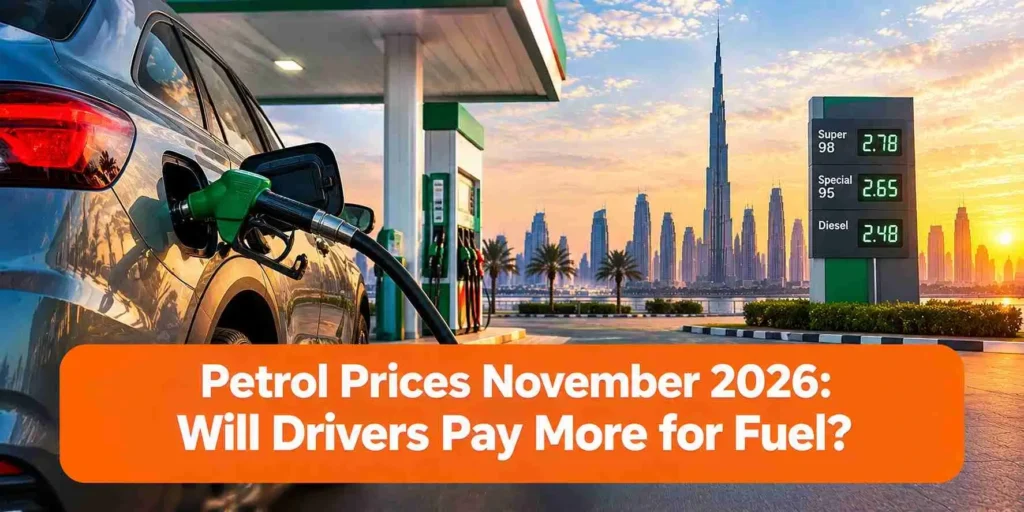
Motorists across the United Arab Emirates are watching international oil prices closely as November approaches. Following significant increases in October, drivers are asking whether the next fuel price announcement will bring another rise in petrol and diesel costs.

The latest market outlook suggests that UAE petrol prices November 2026 could increase for the fourth consecutive month. According to The National, geopolitical tensions, uncertainty surrounding Middle East oil shipments and rising crude prices are adding pressure to the international energy market. However, the final November rates have not yet been officially confirmed.

For drivers who regularly travel across Dubai, Abu Dhabi, Sharjah and other emirates, another increase could mean higher monthly transport expenses. Here is what motorists need to know about October’s confirmed rates, the November forecast and the factors that could influence the next adjustment.

UAE Petrol Prices November 2026: What to Expect

The possibility of another increase has strengthened as international crude prices have climbed. Brent crude tested approximately $115 per barrel on October 23, according to The National, reflecting renewed concerns about regional security and the reliability of oil transportation routes.

The possibility of another increase has strengthened as international crude prices have climbed. Brent crude tested approximately $115 per barrel on October 23, according to The National, reflecting renewed concerns about regional security and the reliability of oil transportation routes.

Nevertheless, a rise is not guaranteed. Changes in crude prices, refined petroleum product costs, shipping expenses and geopolitical developments could influence the final calculation.

Motorists should therefore treat the current outlook as a forecast rather than an official announcement. The new rates are expected to be announced at the end of October and take effect on November 1.

Also Read: Petrol Price in UAE: How Monthly Fuel Prices Are Calculated and Why They Change

October 2026 Fuel Prices in the UAE

Before considering the next adjustment, drivers should understand the current rates. The UAE announced higher petrol and diesel prices for October, with petrol increasing by approximately 16% across all three grades compared with September.

Fuel Type September 2026 October 2026
Super 98 AED 3.80 AED 4.40
Special 95 AED 3.69 AED 4.28
E-Plus 91 AED 3.61 AED 4.21
Diesel AED 4.30 AED 4.80

All prices are per litre.

The increase has raised the cost of filling up for private motorists and businesses that depend on road transport. For example, filling a 60-litre tank with Special 95 costs AED 256.80 at October rates, compared with AED 221.40 in September.

That represents an increase of AED 35.40 for a full tank. If November brings another rise, motorists could face additional expenses when refuelling.

Why Could UAE Fuel Prices Increase Again?

Several factors are influencing the UAE petrol price forecast for November.

1. Rising International Crude Oil Prices

Crude oil is a major influence on global petroleum markets. When international benchmarks rise, the cost of producing and supplying fuel can also increase.

In October, Brent crude climbed to five-month highs amid renewed geopolitical concerns. The National reported that Brent was testing $115 per barrel on October 23, increasing the risk of another rise in UAE pump prices.

However, retail petrol prices do not move automatically with every change in crude oil. The monthly pricing process considers broader market conditions, including refined-product prices and associated costs.

2. Geopolitical Tensions in the Middle East

Political and security developments can influence oil production, exports and transportation. When traders anticipate possible disruptions, they may price additional risk into energy markets.

Concerns about attacks and regional instability have contributed to recent increases in crude prices. If tensions continue during the remainder of October, international energy markets could remain under pressure.

On the other hand, diplomatic progress and reduced security risks could help ease market concerns. Any sustained improvement in regional stability may support lower oil prices over time.

3. Uncertainty Around the Strait of Hormuz

The Strait of Hormuz is an important route for global energy shipments. Disruptions or uncertainty around shipping through the waterway can affect transportation costs and the reliability of oil deliveries.

Even when exports recover, concerns about future disruptions may keep prices elevated. According to The National, the recovery in Gulf crude flows has not eliminated uncertainty surrounding shipping security and market supply.

For the UAE fuel market, developments affecting regional shipping could therefore influence the outlook for November.

4. Higher Shipping and Transportation Costs

Oil prices are not the only factor affecting fuel markets. Tanker availability, freight rates, insurance costs and transportation risks can also influence the expense of moving crude oil and refined products.

When shipping becomes more expensive or less predictable, those pressures can contribute to higher international energy costs.

However, the extent to which these factors affect retail fuel rates depends on overall market conditions and the monthly pricing review.

However, the extent to which these factors affect retail fuel rates depends on overall market conditions and the monthly pricing review.

At participating barrier-free parking locations, cameras can identify a vehicle’s licence plate when it enters and exits. The parking system calculates the applicable fee and the amount is automatically deducted from the customer’s Salik eWallet.

How Another Fuel Price Increase Could Affect Drivers

Higher petrol prices can affect household budgets, particularly for people who commute daily, travel long distances or regularly drive larger vehicles.

Even a small increase per litre can add up over several refuelling stops.

Illustrative Increase Extra Cost for a 60-Litre Tank Extra Cost for an 80-Litre Tank
AED 0.05 per litre AED 3 AED 4
AED 0.10 per litre AED 6 AED 8
AED 0.20 per litre AED 12 AED 16

These examples are calculations, not predictions of November prices.

For someone using 240 litres of petrol each month, a rise of AED 0.10 per litre would increase monthly fuel spending by AED 24. A larger increase would have a greater impact, especially for delivery drivers, sales professionals and others who spend substantial time on the road.

Businesses operating fleets may also need to review transport budgets if fuel expenses continue to rise.

How Are Monthly Fuel Prices Set in the UAE?

The UAE introduced a fuel price deregulation policy in August 2015, linking domestic petrol and diesel prices to international market conditions. The relevant committee reviews prices each month.

This means fuel rates can rise or fall depending on developments in global energy markets. The monthly adjustment is not based solely on the crude oil price recorded on one particular day.

International petroleum product prices and associated supply and distribution costs also matter. As a result, short-term fluctuations do not always translate directly into an equivalent change at petrol stations.

For motorists, the most reliable information comes from the official monthly announcement rather than estimates based on daily crude prices or social media speculation.

UAE Petrol Price Forecast November 2026: Could Rates Fall Instead?

Although the current outlook points towards another increase, prices could move differently if market conditions change.

A reduction in geopolitical tensions, more secure shipping routes or a sustained decline in international crude prices could ease upward pressure. Improved confidence in oil supplies may also reduce the additional risk premium currently influencing the market.

However, a temporary drop in crude prices does not necessarily guarantee cheaper petrol the following month. The broader pricing period and refined-product market conditions remain important.

Conversely, continued supply concerns and elevated oil prices could strengthen the possibility of another increase.

Drivers should monitor the official announcement at the end of October rather than assume that the latest international price automatically determines the November rate.

Practical Ways to Manage Fuel Expenses

While motorists cannot control international oil prices, a few driving habits can help reduce fuel consumption.

These measures will not eliminate the impact of rising prices, but they can help motorists manage their overall driving costs.

Final Thoughts

The outlook for UAE petrol prices November 2026 currently points towards the possibility of a fourth consecutive monthly increase. Higher international crude prices, geopolitical uncertainty and risks affecting regional oil shipments are contributing to the pressure.

October’s confirmed rates stand at AED 4.40 per litre for Super 98, AED 4.28 for Special 95, AED 4.21 for E-Plus 91 and AED 4.80 for diesel. Another increase could add to the cost of daily commuting and business transportation.

However, November’s official prices have not yet been announced, and the final adjustment will depend on market conditions through the end of October.

Motorists should follow official updates, plan their fuel budgets carefully and adopt efficient driving habits while waiting for confirmation.

For more UAE automotive news, petrol price updates, traffic information and vehicle guides,  schedule a service today with Miss Auto UAE.

Frequently Asked Questions

Will UAE petrol prices increase in November 2026?

Another increase is possible, with international oil prices and geopolitical uncertainty putting upward pressure on the market. However, the final rates have not yet been officially announced.

October rates are AED 4.40 per litre for Super 98, AED 4.28 for Special 95 and AED 4.21 for E-Plus 91. These rates apply across the UAE.

The announcement is expected at the end of October, with the new prices scheduled to take effect on November 1.

The UAE reviews fuel prices monthly under a mechanism linked to international energy markets and relevant supply costs.

Drivers can reduce unnecessary journeys, maintain tyre pressure, service their vehicles regularly, drive smoothly and consider alternative transport for suitable trips.

Author

  • Max Wheeler

    Max Wheeler is a automotive writer known for insightful car reviews, maintenance guides, and industry updates. His goal is to help drivers stay informed and confident on the road.

Shares: