

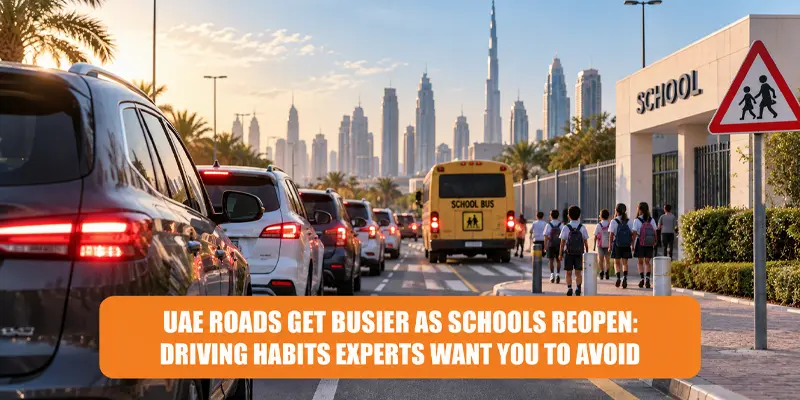

The return of schools across the UAE marks the end of the quieter summer period and the beginning of another challenging season for motorists. Morning drop-offs, afternoon pick-ups, school buses, pedestrians and regular commuters are once again converging on roads across the country.

As schools reopen, UAE school reopening traffic is becoming an important concern for parents, teachers and daily commuters. Around 47% of students travel to school by private vehicle, according to figures cited by Gulf News, adding considerable pressure to roads during peak school hours.
While some congestion is unavoidable, certain driving behaviours can make delays considerably worse. Sudden lane changes, last-minute merging, unnecessary braking, mobile-phone use, double-parking and blocking junctions can all disrupt traffic flow.
With UAE roads traffic 2026 becoming particularly busy around school start and finish times, understanding which habits to avoid can help make daily journeys safer and less stressful.
Why Does UAE School Reopening Traffic Get Worse?
The return of schools puts thousands of additional vehicles on roads during the same periods when many people are travelling to work.
Parents rushing to drop children off may change lanes repeatedly, stop close to school entrances or look for shortcuts through already congested roads. Although these actions may appear to save time, they can contribute to longer delays for everyone.
Traffic experts cited by Gulf News note that congestion is not caused solely by the number of vehicles. Individual driving behaviour can also interrupt traffic flow and create a ripple effect across surrounding roads.
This makes practical school reopening driving tips UAE motorists can follow particularly important.
Driving Habits to Avoid During the School Run
Sudden Lane Changes
Constantly changing lanes to find a faster-moving queue can actually make traffic worse. Sudden movements force other motorists to brake or adjust their speed, disrupting traffic across multiple lanes.
Best practice: Choose your lane early and avoid unnecessary changes near schools and junctions.
Last-Minute Merging
Waiting until the last moment to merge can create bottlenecks, particularly around school entrances and busy intersections.
Best practice: Plan your route ahead and merge smoothly when a safe gap is available.
Unnecessary Braking
Repeated unnecessary braking can create a chain reaction. One vehicle slows down, the next brakes harder and the effect continues through the queue.
Best practice: Maintain a safe following distance and keep your speed steady whenever conditions allow.
Blocking Yellow Box Junctions
Entering a junction without enough space to exit can prevent cross traffic from moving. During peak school hours, this can quickly create a larger bottleneck.
Best practice: Enter a yellow box only when there is enough space to completely clear the junction.
Double-Parking
Stopping in an active lane for a quick school drop-off can reduce road capacity and obstruct school buses, pedestrians and other vehicles.
During Dubai school traffic, parents should use designated drop-off and pick-up areas.
Best practice: Follow school traffic procedures and never stop where your vehicle blocks moving traffic.
Using Your Phone
Checking messages, changing music or handling navigation while driving creates unnecessary distraction.
The Gulf News report states that using a mobile phone while driving carries an AED 800 fine and four black points.
Best practice: Set navigation and other controls before starting your journey and keep your phone away while driving.
Leaving Excessive Gaps
A safe following distance is essential, but unnecessarily large gaps in slow-moving traffic can reduce the number of vehicles clearing a junction during each green-light cycle.
Best practice: Maintain a safe distance while moving forward steadily with traffic.
Safe Driving Near Schools UAE: What Should Drivers Watch For?
School zones require additional attention because motorists share the road with children, pedestrians, school buses and parents.
Drivers should watch for:
- Children crossing roads
- School buses stopping and starting
- Pedestrians near crossings
- Vehicles entering and leaving school entrances
- Parents dropping off children
- Traffic officers and school-zone personnel
- Sudden movements from pedestrians or vehicles
The objective of safe driving near schools in the UAE motorists should practise is not simply avoiding fines. It is about anticipating what other road users may do and giving yourself enough time to react.
School Bus Safety: Don't Ignore the Stop Sign
School buses are an important part of the morning and afternoon traffic environment.
When a school bus stops to allow children to board or leave, motorists should remain alert and follow applicable traffic rules.
Dubai Police has reminded motorists to stop when a school bus displays its stop sign and not to overtake the bus while the sign is activated.
Best practice: Slow down around school buses, remain alert and never attempt risky overtaking.
Follow School-Zone Speed Limits
Speed management is particularly important around schools because children and pedestrians can move unexpectedly.
Drivers should follow posted speed limits and adjust their speed according to traffic and road conditions.
The Gulf News report notes that school-zone speeding penalties can range from AED 300 to AED 3,000 depending on the offence.
Best practice: Follow the posted speed limit and slow down when pedestrian activity or congestion requires additional caution.
UAE School Traffic Infographic: Driving Habits to Avoid
| Driving Habit | Why It Creates Problems | Better Approach |
| Sudden lane changes | Forces other drivers to brake | Choose your lane early |
| Last-minute merging | Creates bottlenecks | Merge smoothly |
| Unnecessary braking | Creates a chain reaction | Maintain steady speed |
| Blocking yellow boxes | Stops cross traffic | Enter only when you can clear it |
| Double-parking | Blocks traffic lanes | Use designated areas |
| Using your phone | Causes distraction | Put your phone away |
| Huge gaps at signals | Reduces traffic flow | Move forward steadily |
| Speeding near schools | Increases safety risks | Follow posted limits |
| Aggressive driving | Creates unpredictable manoeuvres | Stay calm |
| Ignoring bus signs | Puts children at risk | Stop and follow bus rules |
UAE Road Safety Tips for Parents
Parents can make the school run safer and more efficient by following a few simple habits.
Leave Earlier
Allow additional time for congestion instead of rushing.
Use Designated Drop-Off Areas
Never stop in active lanes or block school entrances.
Keep Children Secure
Ensure children are properly seated and restrained before driving.
Stay Focused
Avoid mobile-phone use and other distractions.
Be Patient
Accept that traffic will naturally be heavier during peak school hours.
Follow Traffic Officers
When traffic is manually managed around a school, follow the instructions of authorised personnel.
Watch for Pedestrians
Children may move unpredictably around entrances and crossings.
These simple UAE road safety tips can make school journeys safer for everyone.
Common UAE School Traffic Fines
| Violation | Reported Penalty |
| Using a mobile phone while driving | AED 800 + 4 black points |
| Stopping on a pedestrian crossing / double-parking | AED 500 |
| Blocking pedestrian movement | AED 400 |
| Certain child-seat/front-seat violations | AED 400 |
| School-zone speeding | AED 300–AED 3,000 |
Penalties should be verified against the latest official UAE traffic regulations before publication.
How Much Extra Time Should You Allow?
One of the simplest school reopening driving tips in the UAE motorists can follow is leaving earlier.
A journey that normally takes 20 minutes can take significantly longer during school-run hours. Gulf News cited advice suggesting some motorists may need to leave 40 to 45 minutes earlier during particularly busy periods.
Instead of trying to recover lost time through speeding or aggressive driving, building a time buffer into your schedule can make the commute less stressful.
Why Small Driving Mistakes Create Bigger Traffic Jams
One of the biggest lessons from UAE school reopening traffic is that congestion is not always simply about the number of vehicles.
A single unnecessary lane change can cause another driver to brake. That driver affects the next vehicle, and the effect can continue through the traffic stream.
The same can happen when someone blocks a junction, stops in a moving lane or reacts late to a traffic signal.
These small disruptions can eventually create significant queues, making predictable and consistent driving particularly important during school hours.
UAE Roads Traffic 2026: What Should Drivers Expect?
As schools reopen and regular commuting patterns resume, UAE roads traffic 2026 is expected to remain challenging around school start and finish times.
Major urban areas already experience busy peak-hour conditions, while school journeys add another layer of vehicle movement.
The solution is not always finding a faster shortcut. Better driving discipline can often make a bigger difference.
Staying patient, maintaining safe distances, avoiding unnecessary lane changes and following school-zone procedures can help motorists navigate busy roads more efficiently.
Dubai School Traffic: Can Drivers Help Reduce Congestion?
Congestion around schools cannot be eliminated completely, but driver behaviour can influence how severe it becomes.
Parents who avoid double-parking, use designated drop-off areas and arrive with enough time are less likely to create unnecessary bottlenecks.
Commuters travelling through school zones also have a role to play. Slowing down, remaining alert and accepting that traffic will be heavier can make these areas safer.
The responsibility is therefore shared between parents, commuters, schools, traffic authorities and other road users.
UAE School Traffic Safety Checklist
| Safety Checklist | What to Do |
| Leave Early | Allow extra time for congestion |
| Phone Away | Avoid distractions while driving |
| Stay in Lane | Avoid unnecessary lane changes |
| Watch School Buses | Follow stop signs and safety rules |
| Watch Children | Stay alert near crossings |
| Keep Junctions Clear | Don’t block yellow boxes |
| No Double-Parking | Use designated areas |
| Slow Down | Follow school-zone speed limits |
| Stay Calm | Avoid aggressive driving |
| Plan Ahead | Check traffic before leaving |
Final Thoughts
The return of schools has once again made UAE school reopening traffic a daily reality for motorists across the country. While additional vehicles naturally increase congestion, individual driving habits can determine how much worse the situation becomes.
Sudden lane changes, last-minute merging, unnecessary braking, mobile-phone use, double-parking and blocking junctions can disrupt traffic flow and increase risks around busy school zones.
For parents, the best approach is simple: leave earlier, stay calm, follow school-zone rules and use designated drop-off areas.
For other motorists, patience and predictable driving can make the roads safer for everyone.
As Dubai school traffic becomes part of the daily commute again, responsible driving is not simply about reaching your destination faster. It is about creating safer roads for children, pedestrians, parents, school staff and every other road user.
Stay Updated with Miss Auto
Stay informed with Miss Auto for the latest UAE automotive news, UAE roads traffic 2026 updates, Dubai traffic developments, school-zone safety information, driving advice, road regulations, vehicle ownership guides and developments across the UAE automotive market.
FAQs
Why does UAE school reopening traffic become worse?
The reopening of schools adds private vehicles, school buses and pedestrians to roads during already busy peak hours. Behaviours such as double-parking, sudden lane changes and blocking junctions can make congestion worse.
What driving habits should UAE motorists avoid during school hours?
The key driving habits to avoid UAE motorists should include sudden lane changes, last-minute merging, unnecessary braking, mobile-phone use, double-parking, speeding and blocking intersections.
How can parents reduce school-run traffic?
Parents can leave earlier, use designated drop-off areas, avoid double-parking, follow school traffic instructions and remain patient during peak periods.
What are the best school reopening driving tips UAE motorists should follow?
Drivers should plan extra travel time, maintain a safe following distance, avoid distractions, follow speed limits, watch for pedestrians and school buses, and avoid unnecessary lane changes.
Is using a mobile phone while driving allowed in the UAE?
Motorists should not use a mobile phone while driving. The Gulf News report states that mobile-phone use carries an AED 800 fine and four black points.
What should drivers do when a school bus displays its stop sign?
Drivers should stop and follow applicable school-bus safety rules. Motorists should not overtake a school bus while its stop sign is activated.


