

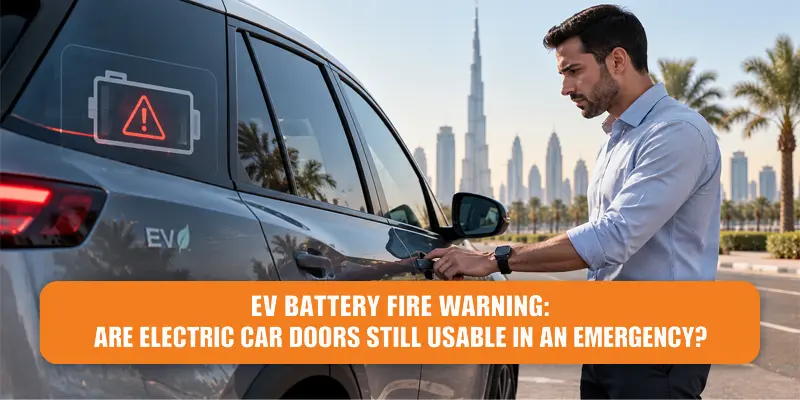

Electric vehicles have transformed modern driving with silent powertrains, advanced software, connected features and futuristic designs. But when an emergency occurs, one basic requirement remains unchanged: occupants need to be able to get out quickly.

That is why the growing use of electronic door handles and concealed emergency releases has raised new questions about EV battery fire emergency situations. What happens if an electric vehicle loses electrical power after a crash? Can the doors still be opened? And can rescuers outside the vehicle quickly find the mechanism needed to get occupants out?
A recent News report highlights growing scrutiny around EV door designs, battery failures and emergency escape systems. In August 2026, China ordered recalls involving about 4.3 million vehicles from Tesla and eight other automakers over concerns that electronic or concealed door handles could become difficult to operate after a crash or electrical failure.
The issue does not mean electric vehicles are inherently unsafe. Instead, it highlights an important aspect of electric vehicle fire safety: emergency systems must remain accessible even when the vehicle’s electronics stop working.
Why Are EV Door Handles Under Scrutiny?
Modern EVs often use electronic buttons, retractable handles and electrically controlled latches instead of traditional mechanical handles.
These systems offer several advantages. They can improve aerodynamics, contribute to a cleaner exterior design and integrate with keyless entry and connected-car technology.
However, an electronic door system can introduce an additional concern during a severe crash or power failure.
If the vehicle’s low-voltage electrical system is compromised, electronically actuated doors may not function normally. Manufacturers generally provide mechanical emergency releases, but their location and operation can differ significantly between models.
For occupants, knowing where the manual release is before an emergency can make an important difference.
Why Seconds Matter During a Fire
In a normal breakdown, an unfamiliar emergency release may simply be inconvenient. During a fire, smoke, heat and panic can make even a simple procedure difficult.
A driver may have only moments to:
- Release the seat belt
- Find the door mechanism
- Open the door
- Help children or passengers exit
- Move away from the vehicle
This makes a clearly visible and intuitive EV emergency exit an important part of overall vehicle safety.
What Happens When an EV Loses Electrical Power?
An EV does not rely on just one battery.
Most modern electric vehicles have a high-voltage traction battery for propulsion and a separate low-voltage electrical system, commonly 12V or 48V, that supports many conventional vehicle functions.
This distinction matters because door locks, windows and other systems can depend on the low-voltage electrical network.
When power is lost, vehicles generally provide mechanical backup mechanisms.
However, these mechanisms can vary by vehicle and seating position. Some may be positioned within the door area, while others can be concealed beneath covers or panels.
Don't Assume Every EV Works the Same Way
One of the biggest lessons for EV owners is that there is no universal electric car door emergency procedure.
A mechanical release may:
- Be located near the interior door handle
- Be hidden underneath a trim cover
- Be positioned inside a door pocket
- Differ between front and rear doors
- Require a specific manual action
Owners should therefore check the emergency-exit instructions in their vehicle’s manual instead of assuming that another EV’s procedure will work on their car.
EV Battery Fire Risks: What Makes Them Different?
The discussion about EV fires often focuses on lithium-ion batteries.
When a high-voltage battery is severely damaged, it can present hazards that differ from conventional petrol or diesel vehicle fires. Battery damage can produce toxic or flammable gases and may also create the possibility of delayed fire.
The US National Highway Traffic Safety Administration advises first responders to treat a damaged high-voltage battery as remaining energised.
This creates a challenging situation for rescuers.
They need to determine:
- Whether occupants can exit normally
- Whether the doors have power
- Where the manual release is located
- Whether the vehicle has sustained structural damage
- Whether the high-voltage battery has been damaged
- Whether smoke or fire presents an immediate hazard
This is why EV battery fire safety involves more than simply extinguishing flames.
Are EVs More Likely to Catch Fire?
Not necessarily.
The News report cites data indicating that EV fires are less frequent than internal-combustion-engine vehicle fires, although EV battery fires can present unique challenges when they occur.
According to figures cited in the report, internal-combustion vehicles experience approximately 1,530 fires per 100,000 vehicles sold, compared with around 25 fires per 100,000 EVs sold.
Therefore, the concern should not be interpreted as saying that EVs are inherently more dangerous.
Instead, the focus is on EV battery fire risks, emergency access and ensuring that occupants and first responders can deal with an incident safely.
What Are Automakers Doing About EV Emergency Exits?
Automakers and regulators are already responding to concerns surrounding electronic door systems.
Tesla’s China recall includes software updates and warning labels intended to make emergency mechanical releases easier to identify. The update is also designed to automatically lower windows after certain collisions, potentially providing another escape route.
Ford’s Mustang Mach-E remedy involved software updates addressing electronic latching behaviour under low-voltage conditions.
Other vehicle manufacturers are improving emergency instructions and labels.
Some vehicles also use systems where interior handles remain mechanically functional even after electrical power is lost.
Why Design Simplicity Matters
An emergency release should ideally be:
| Safety Requirement | Why It Matters |
| Clearly visible | Occupants can find it quickly |
| Mechanically operable | Can work during power loss |
| Easy to understand | Reduces confusion under stress |
| Accessible | Allows occupants to escape |
| Clearly labelled | Helps passengers and rescuers |
| Model-specific instructions | Avoids incorrect emergency procedures |
The growing scrutiny suggests that emergency access should be considered just as important as everyday convenience and styling.
The Challenge for Firefighters and Rescuers
An occupant may know how their own vehicle works. A firefighter arriving at an unfamiliar EV may not.
During an EV battery fire emergency, rescuers may need to quickly determine whether the door has a mechanical release, whether the release works without power and whether the glass can be used as an alternative escape route.
The situation becomes more complicated if the vehicle has been severely damaged.
Questions rescuers may need to consider include:
- Is the door mechanically jammed?
- Is the emergency release accessible?
- Is the glass laminated?
- Can a window be opened?
- Has the high-voltage battery been damaged?
- Are there dangerous gases or electrical hazards?
Kindly note that rescuers can face both access problems and potential hazards from a damaged high-voltage battery.
Electric Car Safety UAE: What Should Drivers Know?
The UAE’s growing EV adoption makes emergency awareness increasingly relevant to local drivers.
Whether driving in Dubai, Abu Dhabi, Sharjah or other parts of the country, EV owners should understand their vehicle’s emergency systems before an incident occurs.
Check Your EV's Emergency Release
Read the owner’s manual and identify the mechanical door releases for both the front and rear seating areas.
Do not wait until a crash or fire to discover where they are located.
Understand Window Operation
Some EVs rely heavily on electronic window controls. Knowing whether windows can be manually operated during a power failure can help occupants understand their available escape options.
Keep Emergency Information Accessible
Drivers should know the vehicle’s emergency instructions and ensure passengers, particularly family members who regularly use the vehicle, understand the basic escape procedure.
Follow Fire and Rescue Instructions
If an EV is involved in a serious crash or shows signs of smoke or fire, occupants should prioritise getting away from the vehicle and contacting emergency services rather than attempting to investigate the battery themselves.
EV Battery Fire Emergency: What Should Occupants Do?
If an EV is smoking, burning or seriously damaged after a collision, staying calm is critical.
1. Exit as soon as it is safe to do so.
Use the normal door if it opens. If it does not, use the vehicle’s documented mechanical emergency release.
2. Help other occupants.
Children, elderly passengers and anyone injured may need assistance getting away from the vehicle.
3. Move away from the vehicle.
Once outside, create distance rather than remaining beside the damaged EV.
4. Contact emergency services.
Provide information that the vehicle is an electric vehicle if relevant.
5. Do not approach a severely damaged high-voltage battery.
A damaged battery can remain hazardous even when the vehicle appears switched off.
6. Follow instructions from emergency responders.
Firefighters are trained to assess the risks associated with damaged EV batteries.
What Does the Future of EV Door Design Look Like?
The debate surrounding electronic door handles is unlikely to disappear as vehicles continue developing software-defined vehicles.
The challenge is finding the right balance between futuristic design, aerodynamics, convenience and emergency usability.
China’s 2026 regulatory action is a significant development. The country has moved toward restricting concealed door handles on new vehicles from 2027 and has ordered a major recall involving approximately 4.3 million vehicles.
The direction is clear: emergency access cannot depend entirely on an electronic system or an obscure procedure.
Quick Safety Checklist
Before driving an EV:
- Locate the manual emergency door releases
- Check front and rear escape procedures
- Understand window operation during power loss
- Read the manufacturer's emergency instructions
- Make sure regular passengers know the basics
- Keep emergency numbers readily available
Final Thoughts
The rise of electronic door handles does not make EVs inherently unsafe. Instead, it highlights an important principle of electric vehicle fire safety: the most critical safety functions should remain accessible when technology fails.
An EV may be a sophisticated computer on wheels, but its doors still serve one fundamental purpose, allowing people to escape.
For UAE drivers, understanding the electric car door emergency procedure for their specific vehicle is a simple but valuable safety step. Knowing where the mechanical release is located before an incident can reduce confusion when every second matters.
As EV technology continues to evolve, manufacturers will need to ensure that sleek designs and electronic systems never compromise the basic requirement of a reliable EV emergency exit.
Stay Informed with Miss Auto
From EV safety and new vehicle technology to UAE automotive trends, road safety and maintenance advice, Miss Auto keeps drivers informed with practical and easy-to-understand automotive content.
Follow Miss Auto for the latest developments shaping the UAE’s rapidly changing automotive landscape.
FAQs
Can an EV door open if the battery dies?
Many EVs provide mechanical emergency releases that can operate without electrical power. However, the location and operation differ between models, so owners should check their vehicle’s manual.
What is an EV battery fire emergency?
An EV battery fire emergency refers to a situation involving an electric vehicle where its high-voltage battery is damaged, overheating, smoking or burning and occupants may need to evacuate quickly.
Are electric vehicles more likely to catch fire?
Available data indicates that EV fires are less frequent than fires involving internal-combustion vehicles, although EV battery incidents can present different challenges for firefighters and rescuers.
Where is the EV emergency exit?
There is no universal location. Depending on the vehicle, the mechanical emergency release may be near the interior door handle, inside a door pocket or beneath a cover.
What are the biggest EV battery fire risks?
Severe battery damage can create electrical hazards, toxic or flammable gases and the possibility of delayed fire. Emergency responders should assess the vehicle rather than occupants attempting to handle a damaged battery themselves.
What should EV owners do to improve safety?
Learn the location and operation of the manual door releases, understand emergency window operation and read the vehicle’s emergency instructions before an incident occurs.

