The UAE’s electric vehicle market is evolving rapidly as more automakers introduce advanced EV technologies designed to improve convenience, efficiency, and charging accessibility. While most manufacturers continue investing heavily in fast-charging infrastructure, NIO is taking a different approach with its innovative battery swap technology.

The debate surrounding NIO battery swap vs fast charging UAE has become increasingly relevant as EV adoption accelerates across the Emirates. With charging times often cited as one of the biggest barriers to EV ownership, NIO’s battery-swapping model presents an alternative solution that could reshape how drivers think about refueling electric vehicles.
For UAE consumers exploring the future of EV mobility, understanding the differences between battery swapping and conventional fast charging is becoming increasingly important.
Table of Contents
- Understanding Battery Swapping and Fast Charging
- NIO’s UAE Electric Vehicle Strategy
- Battery Swap vs Fast Charging: Key Differences
- Benefits of NIO Battery Swap Technology
- Challenges Facing Battery Swapping Networks
- EV Charging Infrastructure in the UAE
- Which Solution Is Better for UAE Drivers?
- The Future of EVs in the UAE
- Final Remarks
- FAQ
Understanding Battery Swapping and Fast Charging
Most electric vehicles today rely on charging stations that replenish battery energy through direct electrical connections. Fast chargers can significantly reduce charging times compared to home charging, but drivers still need to wait while their batteries recharge.
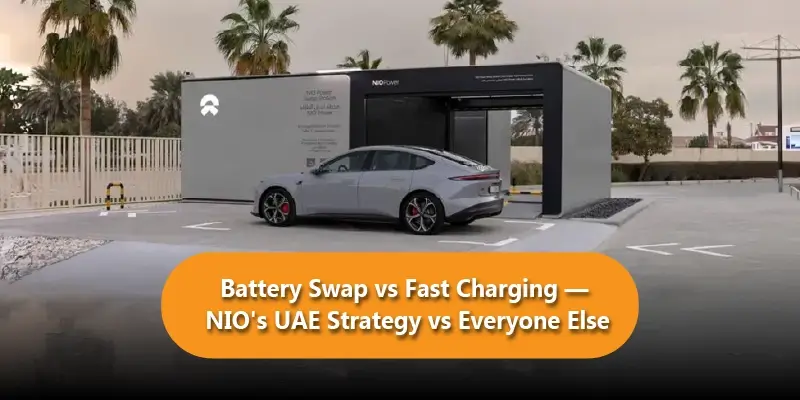
Battery swapping takes a completely different approach. Instead of charging the battery inside the vehicle, a robotic station removes the depleted battery and replaces it with a fully charged unit.
NIO claims that its latest battery swap process can be completed in just a few minutes, making it substantially faster than conventional charging methods and creating a unique advantage within the EV industry.
As a result, the discussion around battery swapping vs fast charging continues to gain momentum among automakers, policymakers, and consumers alike.
NIO's UAE Electric Vehicle Strategy
NIO has entered the UAE market with a strong focus on introducing its battery-swapping ecosystem alongside premium electric vehicles.
The company’s strategy extends beyond simply selling EVs. Instead, NIO aims to create a complete mobility ecosystem that combines:
- Battery Swap Stations
- Connected Vehicle Services
- Smart Energy Management
- Premium Electric Vehicles
- Subscription-Based Battery Options
- Digital Vehicle Integration
This approach differentiates the NIO UAE electric vehicle strategy from most competitors that rely exclusively on charging infrastructure.
As the UAE continues expanding its sustainable transportation initiatives, NIO sees battery swapping as a potential solution to charging-related concerns that may discourage some consumers from switching to EVs.
Battery Swap vs Fast Charging: Key Differences
The primary difference between battery swapping and fast charging lies in how energy is replenished.
| Feature | Battery Swapping | Fast Charging |
|---|---|---|
| Refueling Time | Extremely Fast | Typically Longer |
| Infrastructure Requirement | Dedicated Swap Stations | Charging Stations |
| Battery Ownership | Flexible Options Available | Vehicle Owner Usually Owns Battery |
| Convenience | High | Moderate to High |
| Scalability | More Complex | Easier to Expand |
| Upgradability | Potential Battery Upgrades | Limited |
Battery swapping focuses on speed and convenience, while fast charging emphasizes accessibility and infrastructure expansion.
Both systems offer unique advantages depending on driving habits and regional infrastructure development.
Benefits of NIO Battery Swap Technology
One of the biggest advantages of NIO battery swap technology is the significant reduction in waiting time.
Key Benefits
1. Faster Energy Replenishment
Drivers can receive a fully charged battery within minutes, reducing downtime compared to conventional charging.
2. Reduced Battery Degradation Concerns
Battery ownership models may allow users to access newer battery technologies as they become available.
3. Enhanced Fleet Efficiency
Commercial fleets, ride-hailing operators, and delivery services can maximize vehicle uptime
4. Flexible Battery Upgrades
Users may have the ability to upgrade battery capacity without purchasing an entirely new vehicle.
5. Consistent Battery Monitoring
Centralized battery management enables health monitoring and maintenance across the battery network.
These advantages explain why battery swapping is attracting attention in markets focused on high vehicle utilization.
Challenges Facing Battery Swapping Networks
Despite its benefits, battery swapping also faces several challenges.
Major Challenges
- High infrastructure investment costs
- Need for standardized battery designs
- Limited compatibility between brands
- Complex station deployment requirements
- Battery inventory management
- Geographic coverage limitations
Unlike fast chargers, swap stations require specialized robotic systems and significant capital investment, making large-scale deployment more challenging.
These factors help explain why most global automakers continue prioritizing traditional charging solutions.
EV Charging Infrastructure in the UAE
The UAE has made significant progress in developing its EV ecosystem through investments in charging networks and sustainable transportation initiatives.
Current growth areas include:
- Public charging stations
- Fast charging corridors
- Residential charging solutions
- Commercial charging hubs
- Smart energy integration
- Renewable energy support
The expansion of EV charging infrastructure in the UAE remains critical to supporting future EV adoption regardless of whether battery swapping or charging becomes the dominant solution.
As more electric vehicles enter the market, infrastructure availability will remain a key factor influencing purchasing decisions.
Which Solution Is Better for UAE Drivers?
The answer largely depends on individual driving needs.
Battery Swapping May Be Ideal For:
- High-mileage drivers
- Ride-hailing operators
- Commercial fleets
- Drivers prioritizing minimal downtime
- Urban mobility services
Fast Charging May Be Better For:
- Private vehicle owners
- Long-distance travelers
- Drivers with home charging access
- Areas with extensive charging networks
- Consumers seeking broader infrastructure availability
For many UAE residents, fast charging remains the most accessible solution today, while battery swapping could become increasingly attractive as dedicated swap networks expand.
The Future of EVs in the UAE
The future of EV mobility in the UAE is likely to involve multiple energy replenishment solutions rather than a single dominant technology.
Industry experts expect:
| Future Trend | Expected Impact |
|---|---|
| EV Adoption Growth | Very High |
| Fast Charging Expansion | High |
| Battery Swapping Deployment | Growing |
| Smart Energy Integration | High |
| AI-Based Charging Management | Increasing |
| Battery Innovation | Significant |
The future of EVs UAE will likely be shaped by consumer convenience, infrastructure investment, and technological innovation.
Manufacturers such as NIO are introducing new concepts that challenge traditional assumptions about EV ownership and charging behavior.
Why NIO's Strategy Is Generating Attention
NIO’s approach addresses one of the most common concerns among potential EV buyers: charging time.
By reducing vehicle downtime and introducing flexible battery ownership models, the company offers a compelling alternative to traditional charging systems.
As the UAE continues positioning itself as a leader in sustainable mobility and smart transportation, innovative solutions like battery swapping may play an increasingly important role in the broader EV ecosystem.
Whether battery swapping becomes mainstream or remains a niche solution, NIO’s strategy is already influencing conversations about the next phase of electric vehicle development.
Final Remarks
The debate surrounding NIO battery swap vs fast charging UAE highlights two different visions for the future of electric mobility. While fast charging remains the global standard due to its scalability and widespread adoption, NIO’s battery swap technology introduces a highly convenient alternative that significantly reduces waiting times.
For UAE drivers, both solutions offer valuable benefits depending on usage patterns and infrastructure availability. As EV adoption continues to grow and charging networks expand, battery swapping could emerge as a complementary solution alongside traditional charging rather than a direct replacement.
The coming years will reveal whether NIO’s innovative approach can reshape how electric vehicles are powered in the Emirates and beyond.
FAQ
What is NIO battery swap technology?
NIO battery swap technology allows a depleted EV battery to be automatically replaced with a fully charged battery at a dedicated swap station within minutes.
Is battery swapping faster than fast charging?
Yes. Battery swapping is generally significantly faster because the battery is replaced rather than recharged.
Will NIO build battery swap stations in the UAE?
NIO’s long-term strategy includes expanding its battery-swapping ecosystem alongside vehicle sales, though deployment timelines may vary.
What are the benefits of battery swapping?
Benefits include reduced waiting times, flexible battery upgrades, improved fleet efficiency, and potential battery subscription models.
Is fast charging still important for the UAE?
Absolutely. Fast charging remains essential because it provides widespread accessibility and supports the growing EV market.
Which is the future of EV charging in the UAE?
The future may involve a combination of fast charging, home charging, and battery swapping solutions working together to support increasing EV adoption.