

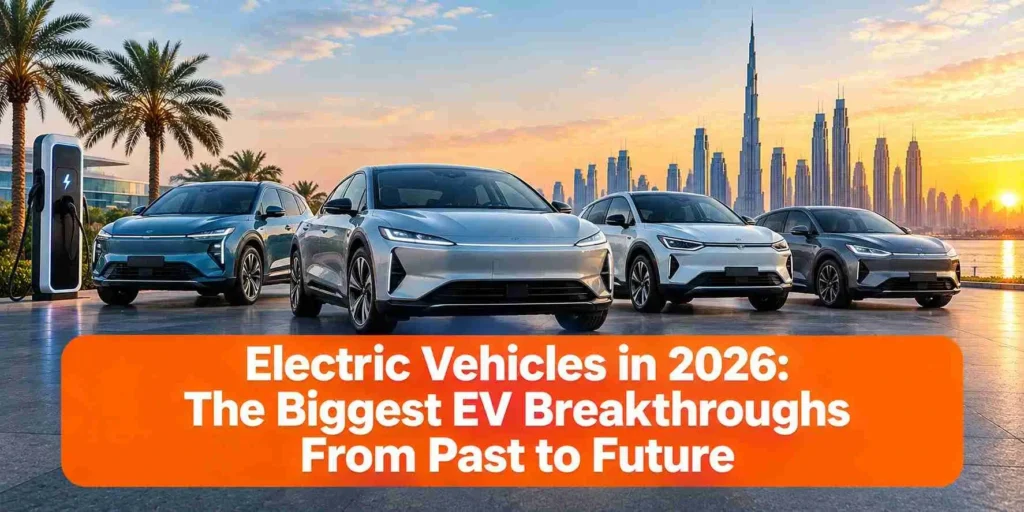

Electric vehicles have travelled a remarkable distance from their earliest experiments to today’s high-performance, long-range and software-driven cars. What was once considered an alternative to petrol-powered transportation has become an important part of the global automotive industry.

As the world marks another World EV Day, the story of electric mobility provides an opportunity to look at how the technology developed, where the industry stands in 2026 and what could shape the future of electric vehicles.
The latest figures show just how far the market has moved. The International Energy Agency (IEA) says global electric car sales exceeded 20 million in 2025, representing around one in four new cars sold worldwide. The number of electric car models is also continuing to grow, with more than 1,000 models expected to be available globally in 2026.
From early electric car experiments to lithium-ion batteries, fast charging and advanced software, every stage has contributed to today’s EV landscape.
How Did Electric Vehicles Begin?
Electric mobility is not a new concept. Experiments with electric-powered vehicles began during the 19th century, well before today’s modern battery-electric cars appeared.
Early inventors experimented with electric motors and rechargeable batteries as alternatives to steam and internal combustion power. By the late 19th and early 20th centuries, electric cars were already being produced commercially in several markets.
Electric vehicles offered some advantages for urban transportation. They were relatively quiet, did not produce exhaust emissions at the vehicle and were easier to operate than some early petrol cars.
However, limitations in battery capacity, charging infrastructure and driving range eventually made petrol-powered vehicles more practical for mass adoption.
EV Innovation History: From Early Cars to Modern EVs
The history of electric vehicles can be divided into several important stages.
| Period | Major Development |
| 1800s | Early experiments with electric motors and batteries |
| Late 1800s | Commercial electric vehicles emerge |
| Early 1900s | EVs compete with petrol and steam vehicles |
| Mid-1900s | EV development continues mainly in specialised applications |
| 1990s | Modern battery-electric vehicle development accelerates |
| 2000s | Lithium-ion batteries transform EV potential |
| 2010s | Mass-market EVs and public charging expand |
| 2020s | EVs become a mainstream global automotive segment |
| 2026 | Battery, charging, software and new vehicle technologies continue advancing |
The modern EV era was particularly influenced by improvements in battery technology. Lithium-ion batteries provided significantly greater energy density than earlier rechargeable battery technologies, helping manufacturers develop vehicles with useful driving ranges.
The Lithium-Ion Battery Changed the EV Industry
Battery technology remains at the centre of electric vehicle technology.
The arrival of commercially viable lithium-ion batteries helped make modern EVs possible because they could store substantially more energy without requiring the extremely heavy battery systems associated with some earlier technologies.
The first electric cars using lithium-ion batteries appeared in the 1990s, while the technology later became central to the rapid growth of modern EVs.
Battery development has continued through improvements in cell chemistry, thermal management, battery-pack design and manufacturing.
According to the IEA, global EV battery deployment reached approximately 1.2 TWh in 2025, almost 30% higher than in 2024 and more than seven times the level recorded in 2020.
EV Breakthroughs 2026: Where Does the Industry Stand?
The EV industry entering 2026 is significantly different from the market of a decade ago.
Electric cars are now available across several vehicle categories, including hatchbacks, sedans, SUVs, performance cars and commercial vehicles. Automakers are also expanding electric offerings across different price points.
The IEA estimates that around 2,500 car models were available globally in 2025, with nearly 1,000 of them being electric. Around 150 new electric models have been announced for 2026.
This increasing variety is one of the biggest EV trends 2026, giving consumers more choices beyond a small group of early electric models.
Electric Car Advancements in Range
Driving range has traditionally been one of the biggest concerns for EV buyers. Modern battery technology has significantly improved this area.
The IEA says the average range of a battery-electric car is now close to 380 km, although range varies significantly depending on vehicle size, battery capacity, driving conditions and technology.
Interestingly, the industry is not simply responding to range concerns by installing increasingly large batteries. More efficient vehicles, improved battery chemistry, better aerodynamics and expanding charging networks are also helping make electric mobility more practical.
For many drivers, access to convenient charging can be just as important as maximum range.
Faster EV Charging Is Changing Daily Driving
Charging technology is another area experiencing rapid development.
Early EVs could require many hours to recharge, making long-distance travel more complicated. Modern DC fast-charging systems can add substantial range in a relatively short period.
Charging networks are also expanding along major highways and urban areas, reducing dependence on home charging.
The improvement is particularly important for drivers who cannot install a private charger. As charging becomes faster and more accessible, the ownership experience increasingly resembles the convenience expected from conventional vehicles.
Battery Chemistry Is Evolving
Not every EV uses exactly the same type of battery.
Lithium iron phosphate, or LFP, has become increasingly important because it can offer cost and durability advantages. According to the IEA, LFP batteries accounted for more than 55% of EV batteries deployed globally in 2025, up from nearly 50% in 2024.
Other battery chemistries continue to be used where energy density and performance are priorities.
Meanwhile, manufacturers are investigating sodium-ion and solid-state technologies that could influence future EV design.
Sodium-Ion Batteries: A Possible Alternative
Sodium-ion batteries are receiving increasing attention because they use sodium rather than lithium as their primary charge carrier.
The technology has potential advantages in areas such as material availability and low-temperature performance. The IEA notes that the latest sodium-ion cells can reach up to around 175 Wh/kg, compared with up to 205 Wh/kg for the latest LFP batteries.
However, sodium-ion technology still has lower energy density and a much smaller manufacturing base than lithium-ion batteries.
For that reason, it may initially find applications where affordability, durability or temperature performance are more important than maximum range.
Solid-State Batteries and the Future of EVs
Solid-state batteries are among the most closely watched technologies in the future of electric vehicles.
Instead of using a liquid electrolyte, solid-state designs use a solid electrolyte. The technology has the potential to deliver higher energy density and other performance benefits, although large-scale production remains a challenge.
Several major manufacturers and battery companies are working towards commercial solid-state applications. The IEA notes that Toyota, BYD, Samsung and other companies have announced development or production timelines extending into the late 2020s and beyond.
If manufacturing costs can be reduced, solid-state batteries could eventually influence EV range, packaging and charging performance.
EVs Are Becoming More Software-Driven
Lorem ipsum dolor sit amet, consectetur adipiscing elit. Ut elit tellus, luctus nec ullamcorper mattis, pulvinar dapibus leo.
EV platforms are well suited to digital control because electric drivetrains have fewer mechanical components than conventional internal combustion powertrains. This makes them compatible with software-based vehicle functions, connected services and automated driving technologies.
Modern EVs can receive software updates, manage charging remotely, optimise energy use and integrate smartphones and connected services.
This means the future EV may increasingly behave like a technology platform as well as a conventional vehicle.
Electric Vehicles 2026: Key Developments
| Area | 2026 Direction |
| Global sales | More than 20 million electric cars sold in 2025 |
| Model availability | More than 1,000 electric models expected in 2026 |
| Average BEV range | Around 380 km globally |
| Battery deployment | 1.2 TWh in 2025 |
| Battery chemistry | LFP gaining significant market share |
| Charging | Faster and increasingly widespread |
| Software | Greater connectivity and digital control |
| Emerging technology | Sodium-ion and solid-state development |
These developments show that EV innovation is no longer focused on one single breakthrough. Progress is happening simultaneously across batteries, charging, software, manufacturing and vehicle design.
What Could the Future of Electric Vehicles Look Like?
The next stage of EV development is likely to focus on making electric cars more affordable, efficient and convenient.
Battery prices have already fallen substantially over the long term, although costs can fluctuate depending on raw materials and manufacturing conditions. The IEA reports that average battery prices declined by 8% in 2025.
Future improvements could come from higher-density batteries, cheaper chemistries, more efficient motors, improved thermal systems and more integrated vehicle platforms.
Charging infrastructure will also remain critical. As EV ownership expands, drivers will need reliable public charging networks alongside home and workplace charging.
EV Trends 2026: Beyond Passenger Cars
Electric mobility is expanding beyond conventional passenger cars.
Electric buses, vans and trucks are becoming increasingly important, particularly in markets where commercial operators can benefit from predictable routes and lower operating costs.
The IEA reports that electric trucks accounted for around 8% of global EV battery deployment in 2025, with battery demand for electric trucks more than doubling during the year.
This suggests that electrification could increasingly affect logistics, public transportation and commercial fleets rather than being limited to private cars.
What Does 2026 Mean for EV Buyers?
For consumers, the biggest change is choice.
There are now more electric models, different battery technologies, improved charging options and a wider range of vehicle sizes. Buyers can choose between compact city cars, family SUVs, luxury EVs and high-performance electric vehicles.
However, the right EV still depends on individual driving patterns. Daily distance, access to charging, climate, vehicle size and budget all influence whether a particular electric car is suitable.
Rather than focusing only on maximum range, buyers should consider the complete ownership experience, including charging availability and energy efficiency.
Final Verdicts
The story of electric vehicles 2026 is the result of more than a century of experimentation and technological development. From early electric cars to modern battery-powered SUVs and performance vehicles, the industry has undergone several major transformations.
Battery technology has been one of the biggest drivers of progress, but today’s EV breakthroughs 2026 extend far beyond batteries. Faster charging, LFP chemistry, software-defined vehicles, improved efficiency, new battery designs and expanding model choices are all shaping the next stage of electric mobility.
The future is likely to bring further changes as manufacturers work on solid-state and sodium-ion batteries while continuing to improve today’s lithium-ion technology.
What began as an alternative form of transportation has become a major part of the global automotive industry. The next chapter will depend on how quickly technology, charging infrastructure, affordability and consumer adoption continue to develop.
Stay Connected with Miss Auto
For the latest EV news, electric car launches, battery technology, charging developments and automotive trends in the UAE and around the world, follow Miss Auto for more updates on the future of mobility.
FAQs
How far have electric vehicles come by 2026?
EVs have evolved from early low-range electric vehicles into modern cars offering significantly greater range, faster charging, advanced software and multiple vehicle configurations.
What is the biggest EV breakthrough in 2026?
There is no single breakthrough defining 2026. Battery chemistry, charging, vehicle software, manufacturing efficiency and increasing model availability are all contributing to EV development.
What is the average EV range in 2026?
The IEA reports that the average range of battery-electric cars is currently close to 380 km, although individual vehicles can have considerably higher or lower ranges.
Are solid-state batteries coming to electric cars?
Several manufacturers are developing solid-state batteries and have announced timelines for future vehicle applications. However, large-scale production and cost remain important challenges.
What are the major EV trends for 2026?
Major trends include growing model availability, improved batteries, faster charging, greater use of LFP chemistry, software integration and continued development of sodium-ion and solid-state batteries.


